Blender Change Composite Without Rendering Again
View Layers can aid you blended images, change a scene, and render final images without having to re-return afterward any alterations. In Blog's Today, nosotros volition notice out more well-nigh what View Layers tin can exercise for your blended render.
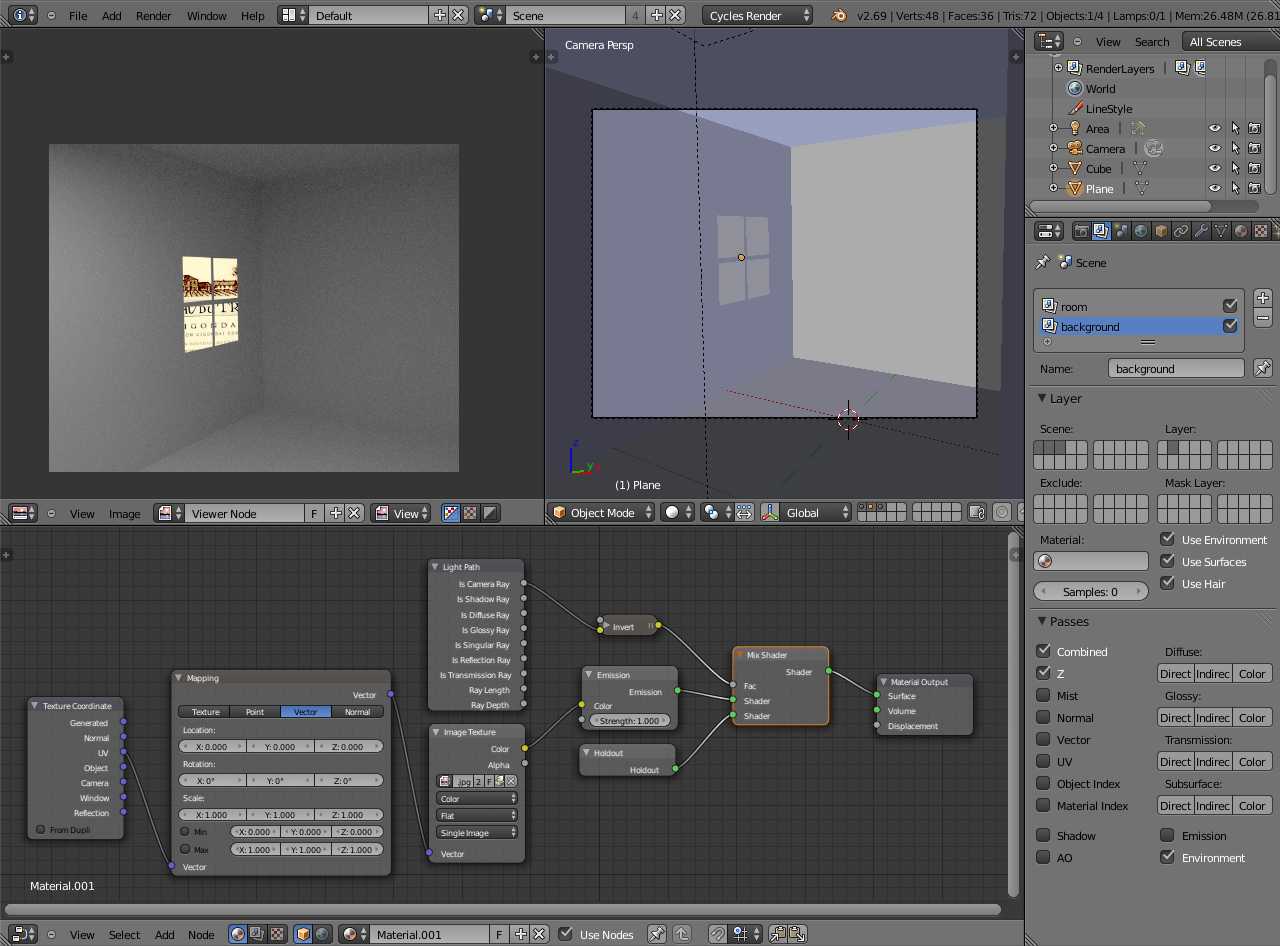
When starting a new .blend file, y'all volition find yourself heavily relying on your Outliner , which is where you can continue track of all your file's data. Your data may be dissever upwardly into scenes, with each having 1 or more layers called View Layers . Each of these layers may and then have one or more collections.
Originally referred to every bit Render Layers in Blender 2.7 , View Layers in Blender 2.8 onward performs the same purpose, but with streamlined simplicity and efficiency. View Layers helps you to more than hands and efficiently separate the objects, lights, and cameras you want to exist visible, and more importantly, rendered in your final scene. In many instances, due to either memory or time constraints, it's more advantageous to split your scene into parts that will exist rendered separately from the other elements in your scene and in one case all elements have been rendered, gather the resulting images together in a layered limerick.
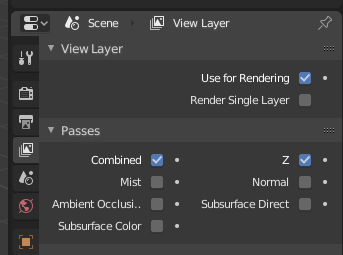
Information technology's possible to create, rename, and remove layers. In the top correct of Blender , there is a drib-downwardly menu for View Layers . You tin access the ability to create or delete a layer on the correct side of the drib-down.
The View Layer panel found in the View Layer Properties tab is where you tin access settings for the agile layer.
- Utilise for Rendering: Cheque this pick to use the agile layer during rendering.
- Render Single Layer: Bank check this choice to only render the active layer.
Before Blender 2.eight, objects would exist sent to dissimilar physical layers that could be called upon in a render or be manipulated independently from other objects by switching to its specific layers. From 2.8 onward, all objects share the aforementioned outliner but tin can exist separated into collections. View Layer can be set so that only specified collections and the objects therein are rendered. Each collection also has settings that can be adjusted for each layer.
- Disable from View Layer: This option removes a collection from the active layer. Objects included in the drove are rendered with the active layer.
- Enable in View Layer: This choice adds a drove to the active layer. Objects included in the collection are rendered with the active layer.
- Set Indirect Only: This option restricts objects in a drove and then that they only contribute to the render through shadows and reflections.
- Clear Indirect But: This option clears the Set Indirect Only flag, then that objects in a collection can fully contribute to the render.
- Set Holdout: This option allows objects in a collection to generate a holdout/mask in the active layer.
- Clear Holdout: This option clears the Ready Holdout flag.
You tin can adjust the way the render engine renders the objects located in each collection. Based on your preferred render engine (internal or third-party), different parameters for each collection can be set. These settings can be accessed from the Outliner , but are hidden. To detect them, go to the Filters pop-over in the Outliner header and enable the visibility "brake toggles."
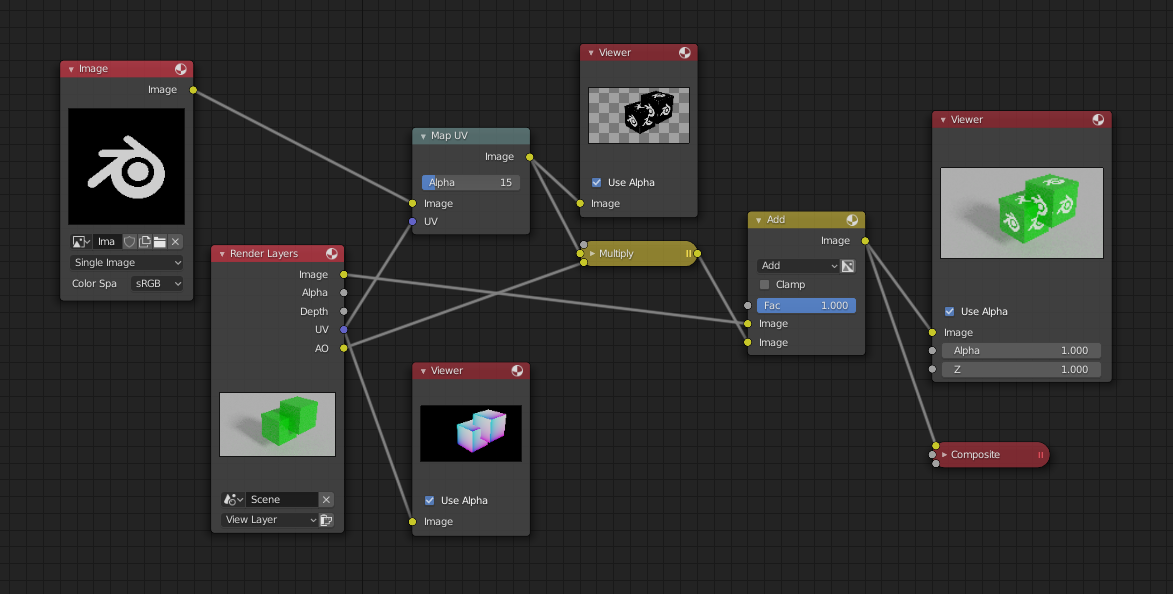
Blender's compositor allows you to assemble and heighten an image using multiple images or image sequences to complete a final composited image. Using limerick nodes, yous can accept two images or cuts of rendered footage together and filter, colorize, and finalize it all at once. Just like the Material creation workflow, Blender's compositor is also node-based. Y'all can change annihilation in your images using nodes. Every augmentation and alteration appears in real time.
Depending on your way of working, a familiar way to build up an image is to call back of Photoshop'due south layering system. The bottom layer in the layer space represents the back of the image, and the top layer represents the front end of the image. When compositing, you should recollect about layering using camera depth: foreground, centre footing, and background. The compositor can mix images of whatsoever size, but you should pay shut attention to your individual image's size and resolution. Distortion and color muting are possible when mixing images with different color depth and resolution parameters.
Additional rules utilize when the compositor works with inputs of differently sized images:
- The output size is defined by the first/top image input socket
- The composite is centered by default, unless you lot use a Translate node to assign a translation to a buffer
Yous tin hands save your image by selecting Image > Save Image (or Alt+Due south) once you lot're satisfied with your composite. The saved paradigm's settings will lucifer the epitome format settings on the Render Properties panel.
iRender is a GPU-Acceleration Deject Rendering Service for Multi-GPU Rendering with Powerful Render Nodes: ii/four/6x RTX 3090/3080/2080Ti, provides high calculating performance on the model of IaaS (Infrastructure-equally-a-Service). Blender users can easily cull their machine configuration from recommended system requirements to high-end options, which suit all your project demands and will speed up your rendering process many times.
High-end hardware configuration
- Single and Multi-GPU servers: ane/2/four/6x RTX 3090/3080/2080Ti. Especially, NVIDIA RTX 3090 – the most powerful graphic card.
- x/24 GB vRAM capacity, fitting to the heaviest images and scenes. NVLink/SLI requested for bigger vRAM.
- A RAM chapters of 128/256 GB.
- Storage (NVMe SSD): 512GB/1TB.
- Intel Xeon Due west-2245 or AMD Ryzen Threadripper Pro 3955WX CPU with a high clock speed of three.90GHz.
- Incredibly, iRender supports NVLink (Asking) which helps yous increase the amount of VRAM to 48GB. This is a technology co-developed by Nvidia and IBM with the aim of expanding the information bandwidth between the GPU and CPU five to 12 times faster than the PCI Express interface.
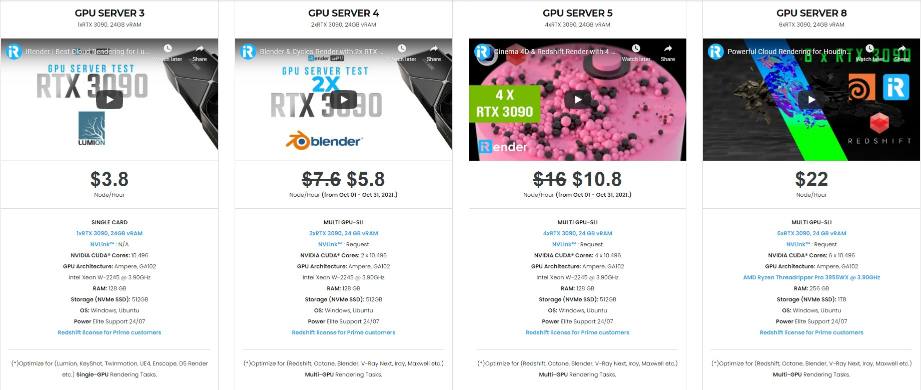
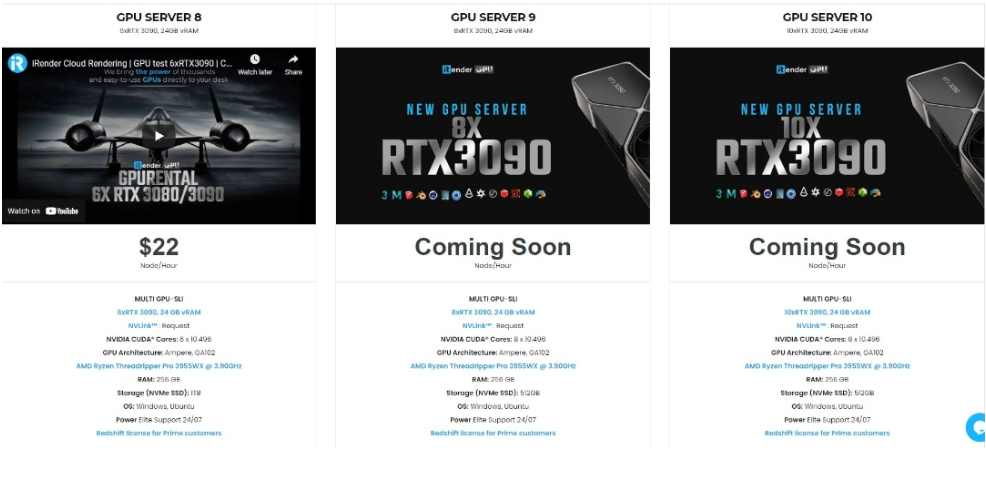
Let's encounter rendering tests with Blender on multi-GPU at iRender:
- Reasonable price
iRender provides high-terminate configuration at a reasonable cost. You can see that iRender's package ever costs much cheaper than packages of other render farms (in performance/price ratio). Moreover, iRender's clients will relish many attractive promotions and discounts. For instance, this October, we offer a promotion for new users and discounted prices for many servers, users will accept advantage of these to level up their renders.
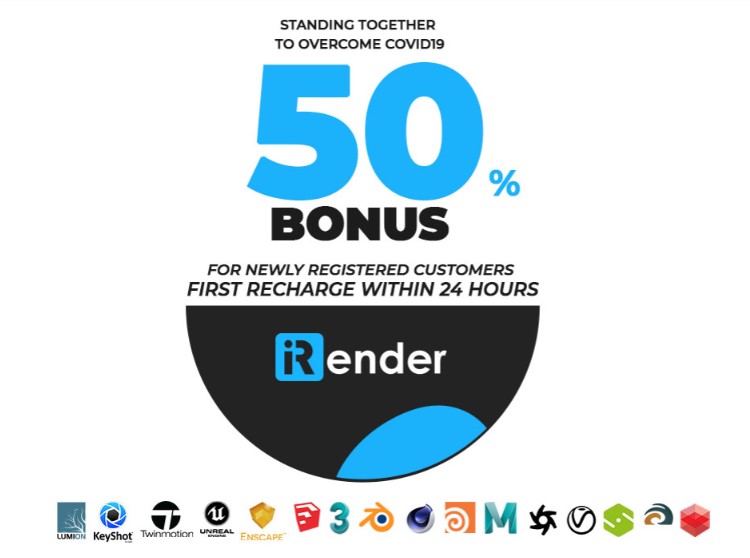
SPECIAL Offering for this October: Get 50% BONUS for all newly registered users.
If yous have whatsoever questions, please exercise not hesitate to accomplish usa via Whatsapp: +(84) 916017116. Register an ACCOUNT today and get Costless COUPON to experience our service. Or contact us via WhatsApp: + (84) 916017116 for advice and support.
Thank you & Happy Rendering!
Source: renderpool.net
17 Mar 2022
Most recently, the Blender Foundation has shipped Blender 3.one, the latest version of this open up-source 3D software. It's a performance-focused…
Source: https://irendering.net/save-time-rendering-with-blenders-view-layers-settings/
0 Response to "Blender Change Composite Without Rendering Again"
Post a Comment