Is the File Management System Where You Can Upload Many Different Types of Files
In computing, file system or filesystem (oft abbreviated to fs) is a method and data construction that the operating system uses to command how data is stored and retrieved.[i] Without a file organisation, information placed in a storage medium would exist 1 large body of data with no mode to tell where one piece of information stopped and the adjacent began, or where any piece of information was located when it was fourth dimension to recollect information technology. By separating the data into pieces and giving each piece a proper name, the data is easily isolated and identified. Taking its proper name from the mode a paper-based information direction arrangement is named, each group of information is called a "file." The structure and logic rules used to manage the groups of data and their names is called a "file arrangement."
There are many different kinds of file systems. Each one has different structure and logic, properties of speed, flexibility, security, size and more. Some file systems have been designed to be used for specific applications. For case, the ISO 9660 file system is designed specifically for optical discs.
File systems can be used on numerous different types of storage devices that apply different kinds of media. As of 2019, hd drives take been key storage devices and are projected to remain so for the foreseeable future.[two] Other kinds of media that are used include SSDs, magnetic tapes, and optical discs. In some cases, such every bit with tmpfs, the computer's primary memory (random-access memory, RAM) is used to create a temporary file system for brusque-term use.
Some file systems are used on local data storage devices;[iii] others provide file access via a network protocol (for case, NFS,[4] SMB, or 9P clients). Some file systems are "virtual", meaning that the supplied "files" (called virtual files) are computed on asking (such as procfs and sysfs) or are merely a mapping into a different file system used as a bankroll store. The file arrangement manages access to both the content of files and the metadata nigh those files. It is responsible for arranging storage space; reliability, efficiency, and tuning with regard to the physical storage medium are important pattern considerations.
Origin of the term [edit]
Earlier the advent of computers the term file arrangement was used to draw a method of storing and retrieving paper documents.[5] By 1961, the term was existence practical to computerized filing aslope the original meaning.[6] Past 1964, it was in general utilize.[7]
Architecture [edit]
A file system consists of two or iii layers. Sometimes the layers are explicitly separated, and sometimes the functions are combined.[8]
The logical file system is responsible for interaction with the user application. It provides the awarding program interface (API) for file operations — Open, Close, READ, etc., and passes the requested operation to the layer beneath it for processing. The logical file system "manage[s] open file table entries and per-process file descriptors".[9] This layer provides "file access, directory operations, [and] security and protection".[8]
The 2d optional layer is the virtual file system. "This interface allows support for multiple concurrent instances of concrete file systems, each of which is chosen a file organization implementation".[9]
The third layer is the physical file system. This layer is concerned with the physical operation of the storage device (e.thou. disk). Information technology processes physical blocks being read or written. It handles buffering and retentivity management and is responsible for the physical placement of blocks in specific locations on the storage medium. The physical file system interacts with the device drivers or with the channel to bulldoze the storage device.[eight]
Aspects of file systems [edit]
Space management [edit]
Annotation: this but applies to file systems used in storage devices.
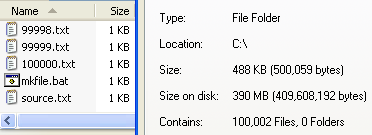
An instance of slack infinite, demonstrated with iv,096-byte NTFS clusters: 100,000 files, each five bytes per file, which equal to 500,000 bytes of bodily data only crave 409,600,000 bytes of disk infinite to store
File systems allocate space in a granular fashion, unremarkably multiple physical units on the device. The file system is responsible for organizing files and directories, and keeping rail of which areas of the media belong to which file and which are not beingness used. For example, in Apple tree DOS of the early 1980s, 256-byte sectors on 140 kilobyte floppy disk used a track/sector map.[ citation needed ]
This results in unused infinite when a file is not an exact multiple of the allocation unit, sometimes referred to as slack space. For a 512-byte allocation, the average unused space is 256 bytes. For 64 KB clusters, the average unused infinite is 32 KB. The size of the allocation unit of measurement is chosen when the file system is created. Choosing the resource allotment size based on the average size of the files expected to be in the file system tin minimize the amount of unusable space. Often the default resource allotment may provide reasonable usage. Choosing an allotment size that is too small results in excessive overhead if the file system will contain more often than not very large files.
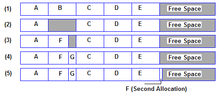
File organisation fragmentation occurs when unused infinite or unmarried files are not face-to-face. As a file system is used, files are created, modified and deleted. When a file is created, the file arrangement allocates space for the data. Some file systems permit or crave specifying an initial infinite allocation and subsequent incremental allocations every bit the file grows. As files are deleted, the infinite they were allocated eventually is considered available for apply by other files. This creates alternate used and unused areas of various sizes. This is gratis space fragmentation. When a file is created and there is non an expanse of contiguous space available for its initial allocation, the infinite must be assigned in fragments. When a file is modified such that it becomes larger, information technology may exceed the space initially allocated to it, another allocation must be assigned elsewhere and the file becomes fragmented.
In some operating systems, a system ambassador may use disk quotas to limit the allocation of disk space.
Filenames [edit]
A filename (or file name) is used to identify a storage location in the file system. Virtually file systems have restrictions on the length of filenames. In some file systems, filenames are not case sensitive (i.e., the names MYFILE and myfile refer to the aforementioned file in a directory); in others, filenames are case sensitive (i.east., the names MYFILE, MyFile, and myfile refer to three separate files that are in the same directory).
Virtually mod file systems let filenames to contain a wide range of characters from the Unicode character set. Still, they may have restrictions on the use of certain special characters, disallowing them within filenames; those characters might exist used to indicate a device, device type, directory prefix, file path separator, or file type.
Directories [edit]
File systems typically accept directories (also called folders) which allow the user to group files into split collections. This may be implemented by associating the file proper name with an index in a tabular array of contents or an inode in a Unix-similar file system. Directory structures may be apartment (i.eastward. linear), or permit hierarchies where directories may contain subdirectories. The commencement file system to support capricious hierarchies of directories was used in the Multics operating system.[10] The native file systems of Unix-like systems also back up arbitrary directory hierarchies, every bit practise, for example, Apple's Hierarchical File Organization, and its successor HFS+ in classic Mac Bone, the FAT file system in MS-DOS 2.0 and later versions of MS-DOS and in Microsoft Windows, the NTFS file organisation in the Windows NT family of operating systems, and the ODS-2 (On-Disk Construction-ii) and higher levels of the Files-11 file arrangement in OpenVMS.
Metadata [edit]
Other bookkeeping information is typically associated with each file within a file organisation. The length of the data contained in a file may exist stored as the number of blocks allocated for the file or equally a byte count. The fourth dimension that the file was last modified may be stored every bit the file's timestamp. File systems might store the file cosmos time, the time it was last accessed, the time the file'due south metadata was changed, or the time the file was concluding backed up. Other information tin include the file'due south device blazon (e.m. cake, character, socket, subdirectory, etc.), its owner user ID and group ID, its admission permissions and other file attributes (e.chiliad. whether the file is read-only, executable, etc.).
A file organisation stores all the metadata associated with the file—including the file name, the length of the contents of a file, and the location of the file in the folder hierarchy—separate from the contents of the file.
About file systems store the names of all the files in 1 directory in one place—the directory table for that directory—which is often stored like any other file. Many file systems put simply some of the metadata for a file in the directory table, and the rest of the metadata for that file in a completely separate structure, such as the inode.
Nearly file systems also shop metadata not associated with whatever one particular file. Such metadata includes information about unused regions—free space bitmap, block availability map—and information near bad sectors. Frequently such information most an resource allotment group is stored inside the resource allotment group itself.
Additional attributes can exist associated on file systems, such as NTFS, XFS, ext2, ext3, some versions of UFS, and HFS+, using extended file attributes. Some file systems provide for user defined attributes such every bit the writer of the document, the character encoding of a document or the size of an epitome.
Some file systems allow for different data collections to exist associated with one file proper name. These separate collections may exist referred to every bit streams or forks. Apple has long used a forked file arrangement on the Macintosh, and Microsoft supports streams in NTFS. Some file systems maintain multiple past revisions of a file under a single file name; the filename by itself retrieves the about recent version, while prior saved version can exist accessed using a special naming convention such as "filename;4" or "filename(-4)" to access the version four saves ago.
Meet comparison of file systems#Metadata for details on which file systems support which kinds of metadata.
File system as an abstract user interface [edit]
In some cases, a file organization may non make apply of a storage device but can be used to organize and represent access to any data, whether it is stored or dynamically generated (e.m. procfs).
Utilities [edit]
File systems include utilities to initialize, alter parameters of and remove an instance of the file system. Some include the ability to extend or truncate the space allocated to the file system.
Directory utilities may be used to create, rename and delete directory entries, which are also known as dentries (singular: dentry),[11] and to alter metadata associated with a directory. Directory utilities may also include capabilities to create additional links to a directory (difficult links in Unix), to rename parent links (".." in Unix-similar operating systems),[ clarification needed ] and to create bidirectional links to files.
File utilities create, listing, copy, move and delete files, and change metadata. They may be able to truncate data, truncate or extend infinite allocation, append to, motion, and change files in-identify. Depending on the underlying structure of the file system, they may provide a mechanism to prepend to or truncate from the beginning of a file, insert entries into the middle of a file, or delete entries from a file. Utilities to costless space for deleted files, if the file system provides an undelete function, besides vest to this category.
Some file systems defer operations such as reorganization of free space, secure erasing of free space, and rebuilding of hierarchical structures past providing utilities to perform these functions at times of minimal activity. An example is the file system defragmentation utilities.
Some of the near important features of file system utilities are supervisory activities which may involve bypassing buying or direct admission to the underlying device. These include high-functioning backup and recovery, data replication, and reorganization of various data structures and allocation tables inside the file organisation.
Restricting and permitting admission [edit]
In that location are several mechanisms used by file systems to control access to data. Usually the intent is to prevent reading or modifying files by a user or grouping of users. Another reason is to ensure data is modified in a controlled way so admission may exist restricted to a specific plan. Examples include passwords stored in the metadata of the file or elsewhere and file permissions in the form of permission bits, access control lists, or capabilities. The need for file system utilities to be able to admission the data at the media level to reorganize the structures and provide efficient backup ordinarily means that these are only effective for polite users but are not effective against intruders.
Methods for encrypting file data are sometimes included in the file system. This is very effective since there is no demand for file arrangement utilities to know the encryption seed to effectively manage the data. The risks of relying on encryption include the fact that an attacker can copy the data and utilize creature force to decrypt the information. Additionally, losing the seed means losing the data.
Maintaining integrity [edit]
One significant responsibleness of a file arrangement is to ensure that the file system structures in secondary storage remain consistent, regardless of the deportment by programs accessing the file system. This includes deportment taken if a program modifying the file system terminates abnormally or neglects to inform the file arrangement that it has completed its activities. This may include updating the metadata, the directory entry and handling any data that was buffered but not yet updated on the physical storage media.
Other failures which the file organization must bargain with include media failures or loss of connection to remote systems.
In the consequence of an operating arrangement failure or "soft" power failure, special routines in the file organization must exist invoked like to when an individual program fails.
The file organization must also be able to correct damaged structures. These may occur equally a result of an operating arrangement failure for which the OS was unable to notify the file system, a power failure, or a reset.
The file organisation must also tape events to allow analysis of systemic issues also equally issues with specific files or directories.
User data [edit]
The most of import purpose of a file system is to manage user data. This includes storing, retrieving and updating data.
Some file systems accept information for storage as a stream of bytes which are collected and stored in a fashion efficient for the media. When a plan retrieves the data, it specifies the size of a retentivity buffer and the file system transfers data from the media to the buffer. A runtime library routine may sometimes permit the user program to ascertain a record based on a library call specifying a length. When the user plan reads the data, the library retrieves information via the file system and returns a tape.
Some file systems permit the specification of a fixed tape length which is used for all writes and reads. This facilitates locating the nthursday record too as updating records.
An identification for each tape, also known as a cardinal, makes for a more than sophisticated file organization. The user program can read, write and update records without regard to their location. This requires complicated direction of blocks of media ordinarily separating key blocks and data blocks. Very efficient algorithms tin can be adult with pyramid structures for locating records.[12]
Using a file system [edit]
Utilities, language specific run-time libraries and user programs use file system APIs to make requests of the file system. These include data transfer, positioning, updating metadata, managing directories, managing access specifications, and removal.
Multiple file systems within a single system [edit]
Often, retail systems are configured with a single file system occupying the unabridged storage device.
Another approach is to partition the deejay so that several file systems with different attributes can be used. 1 file system, for use equally browser enshroud or email storage, might be configured with a minor allocation size. This keeps the activity of creating and deleting files typical of browser activeness in a narrow area of the disk where it will not interfere with other file allocations. Another partition might be created for the storage of audio or video files with a relatively large cake size. Nonetheless another may normally be set read-simply and simply periodically exist set writable.
A tertiary approach, which is mostly used in deject systems, is to use "deejay images" to business firm additional file systems, with the same attributes or not, within another (host) file organisation equally a file. A common instance is virtualization: 1 user tin run an experimental Linux distribution (using the ext4 file system) in a virtual machine under his/her product Windows surroundings (using NTFS). The ext4 file system resides in a deejay image, which is treated as a file (or multiple files, depending on the hypervisor and settings) in the NTFS host file system.
Having multiple file systems on a single arrangement has the boosted benefit that in the effect of a abuse of a single partition, the remaining file systems will frequently still be intact. This includes virus destruction of the organisation partition or even a system that volition non kick. File arrangement utilities which crave dedicated admission can be finer completed piecemeal. In improver, defragmentation may be more than effective. Several arrangement maintenance utilities, such every bit virus scans and backups, can also exist candy in segments. For case, it is not necessary to backup the file system containing videos along with all the other files if none have been added since the final fill-in. As for the image files, one can easily "spin off" differential images which comprise only "new" data written to the primary (original) image. Differential images tin can be used for both condom concerns (as a "disposable" system - can be apace restored if destroyed or contaminated by a virus, every bit the old prototype tin can be removed and a new image can exist created in matter of seconds, even without automated procedures) and quick virtual machine deployment (since the differential images can be quickly spawned using a script in batches).
Blueprint limitations [edit]
All file systems have some functional limit that defines the maximum storable data chapters inside that system. These functional limits are a best-guess attempt by the designer based on how large the storage systems are correct now and how large storage systems are likely to become in the future. Disk storage has continued to increase at near exponential rates (run across Moore'south law), so later on a few years, file systems accept kept reaching design limitations that require reckoner users to repeatedly movement to a newer arrangement with e'er-greater chapters.
File organisation complexity typically varies proportionally with the available storage chapters. The file systems of early on 1980s home computers with 50 KB to 512 KB of storage would not be a reasonable selection for modern storage systems with hundreds of gigabytes of capacity. Likewise, modern file systems would not be a reasonable choice for these early on systems, since the complication of modern file system structures would quickly consume or fifty-fifty exceed the very limited chapters of the early on storage systems.
Types of file systems [edit]
File system types can be classified into deejay/record file systems, network file systems and special-purpose file systems.
Deejay file systems [edit]
A deejay file organisation takes advantages of the ability of disk storage media to randomly address data in a brusk amount of fourth dimension. Boosted considerations include the speed of accessing information following that initially requested and the anticipation that the following data may also be requested. This permits multiple users (or processes) admission to various data on the disk without regard to the sequential location of the information. Examples include FAT (FAT12, FAT16, FAT32), exFAT, NTFS, HFS and HFS+, HPFS, APFS, UFS, ext2, ext3, ext4, XFS, btrfs, Files-11, Veritas File Organisation, VMFS, ZFS, ReiserFS and ScoutFS. Some disk file systems are journaling file systems or versioning file systems.
Optical discs [edit]
ISO 9660 and Universal Disk Format (UDF) are two common formats that target Compact Discs, DVDs and Blu-ray discs. Mount Rainier is an extension to UDF supported since 2.6 series of the Linux kernel and since Windows Vista that facilitates rewriting to DVDs.
Wink file systems [edit]
A wink file system considers the special abilities, functioning and restrictions of flash memory devices. Frequently a disk file organisation can apply a flash memory device as the underlying storage media but it is much better to use a file system specifically designed for a flash device.
Tape file systems [edit]
A record file system is a file arrangement and record format designed to store files on tape. Magnetic tapes are sequential storage media with significantly longer random data access times than disks, posing challenges to the creation and efficient management of a general-purpose file system.
In a deejay file system in that location is typically a master file directory, and a map of used and free data regions. Any file additions, changes, or removals require updating the directory and the used/free maps. Random access to data regions is measured in milliseconds and so this system works well for disks.
Record requires linear move to wind and unwind potentially very long reels of media. This record movement may take several seconds to several minutes to motion the read/write head from one finish of the tape to the other.
Consequently, a master file directory and usage map can be extremely slow and inefficient with tape. Writing typically involves reading the block usage map to find free blocks for writing, updating the usage map and directory to add the data, and and so advancing the tape to write the information in the correct spot. Each additional file write requires updating the map and directory and writing the data, which may take several seconds to occur for each file.
Tape file systems instead typically permit for the file directory to exist spread across the record intermixed with the data, referred to as streaming, so that time-consuming and repeated tape motions are not required to write new data.
Nonetheless, a side effect of this design is that reading the file directory of a tape normally requires scanning the entire tape to read all the scattered directory entries. Most data archiving software that works with tape storage will store a local copy of the tape catalog on a disk file organization, so that adding files to a record can be done quickly without having to rescan the tape media. The local tape catalog re-create is unremarkably discarded if not used for a specified menstruum of fourth dimension, at which point the record must be re-scanned if information technology is to be used in the future.
IBM has adult a file system for tape called the Linear Tape File Organization. The IBM implementation of this file system has been released as the open-source IBM Linear Tape File System — Unmarried Drive Edition (LTFS-SDE) product. The Linear Record File System uses a separate partition on the tape to record the index meta-information, thereby fugitive the problems associated with scattering directory entries across the entire record.
Tape formatting [edit]
Writing data to a tape, erasing, or formatting a tape is often a significantly fourth dimension-consuming process and can take several hours on large tapes.[a] With many data tape technologies information technology is not necessary to format the tape before over-writing new data to the tape. This is due to the inherently subversive nature of overwriting data on sequential media.
Because of the time it can take to format a tape, typically tapes are pre-formatted so that the tape user does non need to spend time preparing each new record for use. All that is usually necessary is to write an identifying media label to the tape before use, and even this can be automatically written by software when a new tape is used for the first time.
Database file systems [edit]
Another concept for file management is the thought of a database-based file system. Instead of, or in addition to, hierarchical structured management, files are identified by their characteristics, like type of file, topic, author, or similar rich metadata.[xiii]
IBM DB2 for i [14] (formerly known equally DB2/400 and DB2 for i5/OS) is a database file system every bit part of the object based IBM i[15] operating system (formerly known as Os/400 and i5/OS), incorporating a single level store and running on IBM Power Systems (formerly known as AS/400 and iSeries), designed by Frank G. Soltis IBM'south onetime chief scientist for IBM i. Around 1978 to 1988 Frank Grand. Soltis and his team at IBM Rochester have successfully designed and applied technologies like the database file system where others similar Microsoft later failed to accomplish.[16] These technologies are informally known equally 'Fortress Rochester'[ commendation needed ] and were in few basic aspects extended from early Mainframe technologies but in many means more than advanced from a technological perspective[ citation needed ].
Another projects that aren't "pure" database file systems but that use some aspects of a database file arrangement:
- Many Web content management systems apply a relational DBMS to store and retrieve files. For example, XHTML files are stored as XML or text fields, while prototype files are stored as blob fields; SQL SELECT (with optional XPath) statements recollect the files, and allow the use of a sophisticated logic and more rich information associations than "usual file systems." Many CMSs likewise take the choice of storing only metadata within the database, with the standard filesystem used to store the content of files.
- Very large file systems, embodied by applications like Apache Hadoop and Google File Arrangement, utilise some database file system concepts.
Transactional file systems [edit]
Some programs need to either make multiple file system changes, or, if ane or more than of the changes fail for whatsoever reason, make none of the changes. For instance, a programme which is installing or updating software may write executables, libraries, and/or configuration files. If some of the writing fails and the software is left partially installed or updated, the software may be broken or unusable. An incomplete update of a key system utility, such equally the command vanquish, may go out the entire system in an unusable state.
Transaction processing introduces the atomicity guarantee, ensuring that operations within of a transaction are either all committed or the transaction can be aborted and the system discards all of its partial results. This means that if at that place is a crash or power failure, after recovery, the stored land will be consistent. Either the software volition be completely installed or the failed installation will be completely rolled dorsum, simply an unusable partial install volition non exist left on the system. Transactions also provide the isolation guarantee[ clarification needed ], meaning that operations within a transaction are hidden from other threads on the organisation until the transaction commits, and that interfering operations on the system will be properly serialized with the transaction.
Windows, beginning with Vista, added transaction support to NTFS, in a characteristic called Transactional NTFS, only its use is now discouraged.[17] There are a number of research prototypes of transactional file systems for UNIX systems, including the Valor file arrangement,[18] Amino,[19] LFS,[20] and a transactional ext3 file system on the TxOS kernel,[21] besides every bit transactional file systems targeting embedded systems, such equally TFFS.[22]
Ensuring consistency across multiple file organisation operations is difficult, if not impossible, without file system transactions. File locking tin can be used as a concurrency control mechanism for individual files, but it typically does not protect the directory construction or file metadata. For instance, file locking cannot prevent TOCTTOU race conditions on symbolic links. File locking also cannot automatically roll back a failed functioning, such as a software upgrade; this requires atomicity.
Journaling file systems is ane technique used to introduce transaction-level consistency to file system structures. Journal transactions are not exposed to programs as function of the OS API; they are just used internally to ensure consistency at the granularity of a single system call.
Data backup systems typically do not provide support for direct backup of data stored in a transactional manner, which makes the recovery of reliable and consistent data sets hard. Well-nigh backup software simply notes what files have changed since a certain time, regardless of the transactional state shared across multiple files in the overall dataset. Equally a workaround, some database systems simply produce an archived state file containing all data up to that point, and the backup software but backs that upwards and does non interact straight with the active transactional databases at all. Recovery requires separate recreation of the database from the state file later the file has been restored by the backup software.
Network file systems [edit]
A network file system is a file system that acts as a client for a remote file access protocol, providing access to files on a server. Programs using local interfaces can transparently create, manage and access hierarchical directories and files in remote network-continued computers. Examples of network file systems include clients for the NFS, AFS, SMB protocols, and file-organisation-like clients for FTP and WebDAV.
[edit]
A shared deejay file system is ane in which a number of machines (usually servers) all have admission to the aforementioned external disk subsystem (usually a SAN). The file system arbitrates access to that subsystem, preventing write collisions. Examples include GFS2 from Cherry-red Hat, GPFS, now known every bit Spectrum Calibration, from IBM, SFS from DataPlow, CXFS from SGI, StorNext from Quantum Corporation and ScoutFS from Versity.
Special file systems [edit]
A special file system presents non-file elements of an operating organisation as files so they can exist acted on using file system APIs. This is most usually washed in Unix-like operating systems, only devices are given file names in some non-Unix-like operating systems also.
Device file systems [edit]
A device file system represents I/O devices and pseudo-devices equally files, chosen device files. Examples in Unix-similar systems include devfs and, in Linux ii.half-dozen systems, udev. In non-Unix-like systems, such as TOPS-x and other operating systems influenced past it, where the total filename or pathname of a file tin can include a device prefix, devices other than those containing file systems are referred to by a device prefix specifying the device, without anything following it.
Other special file systems [edit]
- In the Linux kernel, configfs and sysfs provide files that tin exist used to query the kernel for information and configure entities in the kernel.
- procfs maps processes and, on Linux, other operating organization structures into a filespace.
Minimal file system / audio-cassette storage [edit]
In the 1970s disk and digital tape devices were too expensive for some early microcomputer users. An inexpensive basic data storage organisation was devised that used common audio cassette tape.
When the system needed to write data, the user was notified to printing "RECORD" on the cassette recorder, then press "Render" on the keyboard to notify the system that the cassette recorder was recording. The system wrote a sound to provide time synchronization, so modulated sounds that encoded a prefix, the data, a checksum and a suffix. When the system needed to read data, the user was instructed to printing "PLAY" on the cassette recorder. The system would listen to the sounds on the record waiting until a burst of audio could exist recognized as the synchronization. The organization would then interpret subsequent sounds every bit data. When the data read was consummate, the system would notify the user to printing "STOP" on the cassette recorder. It was primitive, just it (by and large) worked. Data was stored sequentially, ordinarily in an unnamed format, although some systems (such as the Commodore PET series of computers) did allow the files to be named. Multiple sets of data could be written and located by fast-forwarding the tape and observing at the record counter to observe the guess start of the next data region on the record. The user might have to heed to the sounds to find the right spot to brainstorm playing the next information region. Some implementations even included audible sounds interspersed with the data.
Apartment file systems [edit]
In a flat file system, there are no subdirectories; directory entries for all files are stored in a single directory.
When floppy disk media was first available this type of file system was acceptable due to the relatively pocket-sized amount of information space available. CP/M machines featured a apartment file organization, where files could be assigned to one of xvi user areas and generic file operations narrowed to work on one instead of defaulting to work on all of them. These user areas were no more than than special attributes associated with the files; that is, it was not necessary to define specific quota for each of these areas and files could be added to groups for equally long every bit at that place was still free storage infinite on the disk. The early on Apple tree Macintosh also featured a apartment file system, the Macintosh File System. It was unusual in that the file management programme (Macintosh Finder) created the illusion of a partially hierarchical filing system on top of EMFS. This structure required every file to have a unique proper noun, even if it appeared to be in a split folder. IBM DOS/360 and OS/360 store entries for all files on a disk pack (volume) in a directory on the pack called a Volume Table of Contents (VTOC).
While simple, flat file systems become awkward as the number of files grows and makes information technology difficult to organize data into related groups of files.
A recent improver to the flat file arrangement family is Amazon's S3, a remote storage service, which is intentionally simplistic to allow users the ability to customize how their data is stored. The only constructs are buckets (imagine a disk drive of unlimited size) and objects (similar, but not identical to the standard concept of a file). Avant-garde file management is allowed by being able to utilise nearly any character (including '/') in the object'due south proper noun, and the ability to select subsets of the bucket'south content based on identical prefixes.
File systems and operating systems [edit]
Many operating systems include support for more one file system. Sometimes the Os and the file system are so tightly interwoven that it is difficult to separate out file organisation functions.
There needs to be an interface provided past the operating organisation software between the user and the file system. This interface can be textual (such as provided by a command line interface, such equally the Unix shell, or OpenVMS DCL) or graphical (such as provided by a graphical user interface, such as file browsers). If graphical, the metaphor of the folder, containing documents, other files, and nested folders is often used (meet likewise: directory and folder).
Unix and Unix-like operating systems [edit]
Unix-like operating systems create a virtual file organization, which makes all the files on all the devices appear to exist in a single hierarchy. This means, in those systems, there is one root directory, and every file existing on the system is located under it somewhere. Unix-like systems can employ a RAM disk or network shared resource equally its root directory.
Unix-like systems assign a device name to each device, but this is not how the files on that device are accessed. Instead, to gain admission to files on another device, the operating organisation must outset be informed where in the directory tree those files should appear. This procedure is called mounting a file system. For example, to admission the files on a CD-ROM, one must tell the operating system "Take the file system from this CD-ROM and make it announced under such-and-such directory." The directory given to the operating system is chosen the mountain signal – it might, for example, exist /media. The /media directory exists on many Unix systems (every bit specified in the Filesystem Bureaucracy Standard) and is intended specifically for apply equally a mount signal for removable media such as CDs, DVDs, USB drives or floppy disks. Information technology may be empty, or it may contain subdirectories for mounting individual devices. Mostly, but the administrator (i.e. root user) may authorize the mounting of file systems.
Unix-like operating systems often include software and tools that assist in the mounting process and provide it new functionality. Some of these strategies accept been coined "automobile-mounting" as a reflection of their purpose.
- In many situations, file systems other than the root need to be available every bit soon equally the operating organization has booted. All Unix-similar systems therefore provide a facility for mounting file systems at boot time. System administrators define these file systems in the configuration file fstab (vfstab in Solaris), which also indicates options and mount points.
- In some situations, at that place is no need to mount certain file systems at kick time, although their utilise may exist desired thereafter. There are some utilities for Unix-like systems that allow the mounting of predefined file systems upon need.
- Removable media allow programs and data to be transferred between machines without a physical connexion. Common examples include USB flash drives, CD-ROMs, and DVDs. Utilities accept therefore been adult to detect the presence and availability of a medium and and so mount that medium without any user intervention.
- Progressive Unix-similar systems have also introduced a concept chosen supermounting; see, for example, the Linux supermount-ng projection. For example, a floppy disk that has been supermounted can exist physically removed from the system. Nether normal circumstances, the disk should take been synchronized and so unmounted before its removal. Provided synchronization has occurred, a different disk tin be inserted into the bulldoze. The system automatically notices that the disk has changed and updates the mount betoken contents to reverberate the new medium.
- An automounter will automatically mountain a file organization when a reference is made to the directory atop which it should be mounted. This is usually used for file systems on network servers, rather than relying on events such as the insertion of media, as would be appropriate for removable media.
Linux [edit]
Linux supports numerous file systems, just common choices for the system disk on a cake device include the ext* family (ext2, ext3 and ext4), XFS, JFS, and btrfs. For raw flash without a wink translation layer (FTL) or Retention Applied science Device (MTD), at that place are UBIFS, JFFS2 and YAFFS, amid others. SquashFS is a common compressed read-only file organization.
Solaris [edit]
Solaris in earlier releases defaulted to (non-journaled or non-logging) UFS for bootable and supplementary file systems. Solaris defaulted to, supported, and extended UFS.
Support for other file systems and meaning enhancements were added over fourth dimension, including Veritas Software Corp. (journaling) VxFS, Sunday Microsystems (clustering) QFS, Sun Microsystems (journaling) UFS, and Dominicus Microsystems (open source, poolable, 128 scrap compressible, and error-correcting) ZFS.
Kernel extensions were added to Solaris to allow for bootable Veritas VxFS operation. Logging or journaling was added to UFS in Sun's Solaris 7. Releases of Solaris 10, Solaris Express, OpenSolaris, and other open source variants of the Solaris operating arrangement later supported bootable ZFS.
Logical Volume Management allows for spanning a file arrangement across multiple devices for the purpose of adding redundancy, capacity, and/or throughput. Legacy environments in Solaris may use Solaris Book Manager (formerly known as Solstice DiskSuite). Multiple operating systems (including Solaris) may use Veritas Volume Manager. Mod Solaris based operating systems eclipse the need for volume management through leveraging virtual storage pools in ZFS.
macOS [edit]
macOS (formerly Mac Os X) uses the Apple File System (APFS), which in 2017 replaced a file system inherited from classic Mac OS called HFS Plus (HFS+). Apple tree also uses the term "Mac OS Extended" for HFS+.[23] HFS Plus is a metadata-rich and instance-preserving but (usually) case-insensitive file system. Due to the Unix roots of macOS, Unix permissions were added to HFS Plus. Later versions of HFS Plus added journaling to foreclose corruption of the file system structure and introduced a number of optimizations to the allocation algorithms in an attempt to defragment files automatically without requiring an external defragmenter.
Filenames can be up to 255 characters. HFS Plus uses Unicode to store filenames. On macOS, the filetype can come up from the type code, stored in file's metadata, or the filename extension.
HFS Plus has 3 kinds of links: Unix-style hard links, Unix-way symbolic links, and aliases. Aliases are designed to maintain a link to their original file even if they are moved or renamed; they are not interpreted by the file system itself, but by the File Manager code in userland.
macOS 10.13 High Sierra, which was announced on June 5, 2017 at Apple tree'south WWDC event, uses the Apple tree File Organisation on solid-country drives.
macOS also supported the UFS file system, derived from the BSD Unix Fast File Organisation via NeXTSTEP. However, as of Mac OS X Leopard, macOS could no longer exist installed on a UFS volume, nor can a pre-Leopard system installed on a UFS volume exist upgraded to Leopard.[24] As of Mac Os X King of beasts UFS support was completely dropped.
Newer versions of macOS are capable of reading and writing to the legacy Fat file systems (16 and 32) common on Windows. They are likewise capable of reading the newer NTFS file systems for Windows. In order to write to NTFS file systems on macOS versions prior to Mac Bone X Snow Leopard third party software is necessary. Mac OS Ten x.half-dozen (Snow Leopard) and later allow writing to NTFS file systems, but simply after a non-footling system setting change (third party software exists that automates this).[25]
Finally, macOS supports reading and writing of the exFAT file system since Mac OS Ten Snow Leopard, starting from version 10.6.5.[26]
Bone/two [edit]
OS/2 i.2 introduced the Loftier Performance File System (HPFS). HPFS supports mixed case file names in different code pages, long file names (255 characters), more efficient use of deejay infinite, an architecture that keeps related items close to each other on the deejay volume, less fragmentation of data, extent-based space allocation, a B+ tree structure for directories, and the root directory located at the midpoint of the disk, for faster average access. A journaled filesystem (JFS) was shipped in 1999.
PC-BSD [edit]
PC-BSD is a desktop version of FreeBSD, which inherits FreeBSD's ZFS support, similarly to FreeNAS. The new graphical installer of PC-BSD can handle / (root) on ZFS and RAID-Z pool installs and disk encryption using Geli right from the start in an easy user-friendly (GUI) mode. The current PC-BSD nine.0+ 'Isotope Edition' has ZFS filesystem version five and ZFS storage pool version 28.
Programme 9 [edit]
Plan nine from Bell Labs treats everything as a file and accesses all objects as a file would be accessed (i.e., in that location is no ioctl or mmap): networking, graphics, debugging, hallmark, capabilities, encryption, and other services are accessed via I/O operations on file descriptors. The 9P protocol removes the divergence between local and remote files. File systems in Programme 9 are organized with the aid of individual, per-process namespaces, assuasive each process to have a different view of the many file systems that provide resources in a distributed system.
The Inferno operating system shares these concepts with Plan 9.
Microsoft Windows [edit]
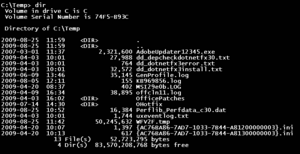
Directory listing in a Windows control vanquish
Windows makes use of the Fat, NTFS, exFAT, Live File System and ReFS file systems (the last of these is simply supported and usable in Windows Server 2012, Windows Server 2016, Windows 8, Windows 8.ane, and Windows 10; Windows cannot kicking from it).
Windows uses a bulldoze letter of the alphabet brainchild at the user level to distinguish one deejay or partition from another. For example, the path C:\WINDOWS represents a directory WINDOWS on the partition represented past the letter of the alphabet C. Bulldoze C: is virtually commonly used for the primary hard disk partition, on which Windows is commonly installed and from which information technology boots. This "tradition" has go then firmly ingrained that bugs exist in many applications which make assumptions that the bulldoze that the operating organization is installed on is C. The use of bulldoze letters, and the tradition of using "C" as the drive letter for the primary hard disk drive partition, can be traced to MS-DOS, where the letters A and B were reserved for upward to ii floppy disk drives. This in turn derived from CP/Grand in the 1970s, and ultimately from IBM'due south CP/CMS of 1967.
Fat [edit]
The family unit of FAT file systems is supported past almost all operating systems for personal computers, including all versions of Windows and MS-DOS/PC DOS, Os/2, and DR-DOS. (PC DOS is an OEM version of MS-DOS, MS-DOS was originally based on SCP'due south 86-DOS. DR-DOS was based on Digital Research'southward Concurrent DOS, a successor of CP/M-86.) The FAT file systems are therefore well-suited equally a universal exchange format between computers and devices of most whatsoever type and age.
The FAT file system traces its roots back to an (incompatible) 8-chip FAT precursor in Standalone Deejay BASIC and the short-lived MDOS/MIDAS project.[ citation needed ]
Over the years, the file organization has been expanded from FAT12 to FAT16 and FAT32. Various features have been added to the file system including subdirectories, codepage support, extended attributes, and long filenames. Third parties such as Digital Inquiry have incorporated optional support for deletion tracking, and volume/directory/file-based multi-user security schemes to back up file and directory passwords and permissions such as read/write/execute/delete access rights. Most of these extensions are not supported by Windows.
The FAT12 and FAT16 file systems had a limit on the number of entries in the root directory of the file system and had restrictions on the maximum size of Fat-formatted disks or partitions.
FAT32 addresses the limitations in FAT12 and FAT16, except for the file size limit of close to 4 GB, but it remains limited compared to NTFS.
FAT12, FAT16 and FAT32 besides accept a limit of eight characters for the file name, and 3 characters for the extension (such as .exe). This is commonly referred to every bit the 8.3 filename limit. VFAT, an optional extension to FAT12, FAT16 and FAT32, introduced in Windows 95 and Windows NT 3.5, immune long file names (LFN) to be stored in the Fatty file system in a backwards uniform style.
NTFS [edit]
NTFS, introduced with the Windows NT operating system in 1993, allowed ACL-based permission command. Other features also supported by NTFS include hard links, multiple file streams, aspect indexing, quota tracking, sparse files, encryption, compression, and reparse points (directories working equally mountain-points for other file systems, symlinks, junctions, remote storage links).
exFAT [edit]
exFAT has certain advantages over NTFS with regard to file system overhead.[ citation needed ]
exFAT is not astern compatible with Fat file systems such as FAT12, FAT16 or FAT32. The file organisation is supported with newer Windows systems, such as Windows XP, Windows Server 2003, Windows Vista, Windows 2008, Windows seven, Windows 8, and Windows x.
exFAT is supported in macOS starting with version 10.half-dozen.5 (Snow Leopard).[26] Support in other operating systems is sparse since implementing support for exFAT requires a license. exFAT is the just file system that is fully supported on both macOS and Windows that can agree files larger than 4 GB.[27] [28]
OpenVMS [edit]
MVS [edit]
Prior to the introduction of VSAM, OS/360 systems implemented a hybrid file system. The arrangement was designed to easily back up removable disk packs, so the data relating to all files on one disk (book in IBM terminology) is stored on that disk in a flat arrangement file called the Volume Tabular array of Contents (VTOC). The VTOC stores all metadata for the file. Afterwards a hierarchical directory structure was imposed with the introduction of the System Itemize, which tin optionally itemize files (datasets) on resident and removable volumes. The catalog simply contains data to relate a dataset to a specific volume. If the user requests access to a dataset on an offline book, and they have suitable privileges, the system will attempt to mount the required volume. Cataloged and not-cataloged datasets tin still exist accessed using data in the VTOC, bypassing the catalog, if the required volume id is provided to the Open up request. Still later the VTOC was indexed to speed upwardly access.
Conversational Monitor System [edit]
The IBM Conversational Monitor System (CMS) component of VM/370 uses a separate apartment file system for each virtual disk (minidisk). File data and control data are scattered and intermixed. The anchor is a record chosen the Principal File Directory (MFD), always located in the quaternary cake on the disk. Originally CMS used fixed-length 800-byte blocks, but later on versions used larger size blocks up to 4K. Access to a data record requires two levels of indirection, where the file's directory entry (called a File Status Tabular array (FST) entry) points to blocks containing a list of addresses of the individual records.
AS/400 file system [edit]
Data on the Every bit/400 and its successors consists of system objects mapped into the system virtual address space in a single-level store. Many types of objects are defined including the directories and files institute in other file systems. File objects, forth with other types of objects, form the basis of the Equally/400's support for an integrated relational database.
Other file systems [edit]
- The Prospero File System is a file system based on the Virtual System Model.[29] The system was created by Dr. B. Clifford Neuman of the Information Sciences Institute at the University of Southern California.
- RSRE FLEX file system - written in ALGOL 68
- The file organization of the Michigan Terminal System (MTS) is interesting because: (i) information technology provides "line files" where record lengths and line numbers are associated as metadata with each record in the file, lines tin can be added, replaced, updated with the same or different length records, and deleted anywhere in the file without the demand to read and rewrite the entire file; (ii) using programme keys files may be shared or permitted to commands and programs in improver to users and groups; and (iii) there is a comprehensive file locking mechanism that protects both the file's data and its metadata.[30] [31]
Limitations [edit]
Converting the type of a file organisation [edit]
It may be advantageous or necessary to have files in a unlike file organization than they currently exist. Reasons include the need for an increase in the infinite requirements beyond the limits of the current file system. The depth of path may need to be increased across the restrictions of the file organisation. There may be performance or reliability considerations. Providing admission to some other operating organization which does not support the existing file organisation is another reason.
In-identify conversion [edit]
In some cases conversion can exist done in-place, although migrating the file system is more conservative, equally it involves a creating a copy of the information and is recommended.[32] On Windows, Fatty and FAT32 file systems can be converted to NTFS via the catechumen.exe utility, merely not the reverse.[32] On Linux, ext2 can be converted to ext3 (and converted back), and ext3 can be converted to ext4 (but non back),[33] and both ext3 and ext4 tin be converted to btrfs, and converted back until the undo information is deleted.[34] These conversions are possible due to using the same format for the file information itself, and relocating the metadata into empty space, in some cases using thin file back up.[34]
Migrating to a different file organisation [edit]
Migration has the disadvantage of requiring additional infinite although it may be faster. The best case is if there is unused space on media which will contain the final file system.
For example, to migrate a FAT32 file system to an ext2 file organization. Beginning create a new ext2 file system, then copy the information to the file system, then delete the FAT32 file organisation.
An culling, when in that location is not sufficient space to retain the original file system until the new one is created, is to utilize a work surface area (such as a removable media). This takes longer only a fill-in of the data is a nice side effect.
Long file paths and long file names [edit]
In hierarchical file systems, files are accessed past ways of a path that is a branching listing of directories containing the file. Unlike file systems have different limits on the depth of the path. File systems also take a limit on the length of an individual filename.
Copying files with long names or located in paths of significant depth from i file system to another may crusade undesirable results. This depends on how the utility doing the copying handles the discrepancy.
See also [edit]
- Comparison of file systems
- Disk quota
- List of file systems
- List of Unix commands
- Directory structure
- Disk sharing
- Distributed file organisation
- Distributed Data Management Architecture
- File managing director
- File system fragmentation
- Filename extension
- Global filesystem
- Object storage
- Physical and logical storage
- Storage efficiency
- Virtual file arrangement
Notes [edit]
- ^ An LTO-half dozen ii.v TB tape requires more than 4 hours to write at 160 MB/Sec
References [edit]
- ^ "v.10. Filesystems". The Linux Document Projection. Retrieved December 11, 2021.
A filesystem is the methods and data structures that an operating system uses to continue track of files on a disk or partition; that is, the fashion the files are organized on the disk.
- ^ "Storage, IT Technology and Markets, Status and Evolution" (PDF). September twenty, 2018.
HDD still key storage for the foreseeable futurity, SSDs not price effective for capacity
- ^ Arpaci-Dusseau, Remzi H.; Arpaci-Dusseau, Andrea C. (2014), File System Implementation (PDF), Arpaci-Dusseau Books
- ^ Arpaci-Dusseau, Remzi H.; Arpaci-Dusseau, Andrea C. (2014), Sun'southward Network File System (PDF), Arpaci-Dusseau Books
- ^ McGill, Florence E. (1922). Office Practice and Business concern Process. Gregg Publishing Company. p. 197. Retrieved Baronial i, 2016.
- ^ Waring, R.L. (1961). Technical investigations of addition of a hardcopy output to the elements of a mechanized library arrangement : final report, twenty Sept. 1961. Cincinnati, OH: Svco Corporation. OCLC 310795767.
- ^ Disc File Applications: Reports Presented at the Nation's First Disc File Symposium. American Data Processing. 1964. Retrieved August 1, 2016.
- ^ a b c Amir, Yair. "Operating Systems 600.418 The File System". Department of Computer Science Johns Hopkins University . Retrieved July 31, 2016.
- ^ a b IBM Corporation. "Component Structure of the Logical File System". IBM Knowledge Middle . Retrieved July 31, 2016.
- ^ R. C. Daley; P. Yard. Neumann (1965). A Full general-Purpose File System For Secondary Storage. Fall Joint Estimator Conference. AFIPS. pp. 213–229. doi:10.1145/1463891.1463915. Retrieved 2011-07-thirty .
- ^ Mohan, I. Chandra (2013). Operating Systems. Delhi: PHI Learning Pvt. Ltd. p. 166. ISBN9788120347267 . Retrieved 2014-07-27 .
The give-and-take dentry is short for 'directory entry'. A dentry is nothing merely a specific component in the path from the root. They (directory proper name or file name) provide for accessing files or directories[.]
- ^ "KSAM: A B + -tree-based keyed sequential-access method". ResearchGate . Retrieved 29 April 2016.
- ^ "Windows on a database – sliced and diced by BeOS vets". theregister.co.united kingdom. 2002-03-29. Retrieved 2014-02-07 .
- ^ "IBM DB2 for i: Overview". 03.ibm.com. Retrieved 2014-02-07 .
- ^ "IBM developerWorks : New to IBM i". Ibm.com. 2011-03-08. Retrieved 2014-02-07 .
- ^ "XP successor Longhorn goes SQL, P2P – Microsoft leaks". theregister.co.united kingdom of great britain and northern ireland. 2002-01-28. Retrieved 2014-02-07 .
- ^ "Alternatives to using Transactional NTFS (Windows)". Msdn.microsoft.com. 2013-12-05. Retrieved 2014-02-07 .
- ^ Spillane, Richard; Gaikwad, Sachin; Chinni, Manjunath; Zadok, Erez and Wright, Charles P.; 2009; "Enabling transactional file access via lightweight kernel extensions"; Seventh USENIX Conference on File and Storage Technologies (FAST 2009)
- ^ Wright, Charles P.; Spillane, Richard; Sivathanu, Gopalan; Zadok, Erez; 2007; "Extending ACID Semantics to the File System; ACM Transactions on Storage
- ^ Seltzer, Margo I.; 1993; "Transaction Support in a Log-Structured File Organization"; Proceedings of the Ninth International Briefing on Data Engineering
- ^ Porter, Donald E.; Hofmann, Owen Southward.; Rossbach, Christopher J.; Benn, Alexander and Witchel, Emmett; 2009; "Operating System Transactions"; In the Proceedings of the 22nd ACM Symposium on Operating Systems Principles (SOSP '09), Big Sky, MT, Oct 2009.
- ^ Gal, Eran; Toledo, Sivan; "A Transactional Flash File System for Microcontrollers"
- ^ "Mac Os X: About file arrangement journaling". Apple tree. Retrieved viii February 2014.
- ^ "Mac OS X 10.v Leopard: Installing on a UFS-formatted volume". apple.com. xix October 2007. Archived from the original on sixteen March 2008. Retrieved 29 April 2016.
- ^ OSXDaily (2013-10-02). "How to Enable NTFS Write Support in Mac Bone Ten". Retrieved half dozen February 2014.
- ^ a b Steve Bunting (2012-08-14). EnCase Calculator Forensics - The Official EnCE: EnCase Certified Examiner. ISBN9781118219409 . Retrieved 2014-02-07 .
- ^ "File system formats bachelor in Disk Utility on Mac". Apple Support.
- ^ "exFAT file system specification". Microsoft Docs.
- ^ The Prospero File Organisation: A Global File System Based on the Virtual System Model. 1992.
- ^ "A file system for a general-purpose time-sharing surround", G. C. Pirkola, Proceedings of the IEEE, June 1975, book 63 no. vi, pp. 918–924, ISSN 0018-9219
- ^ "The Protection of Information in a Full general Purpose Fourth dimension-Sharing Environs", Gary C. Pirkola and John Sanguinetti, Proceedings of the IEEE Symposium on Trends and Applications 1977: Computer Security and Integrity, vol. 10 no. 4, pp. 106-114
- ^ a b How to Convert FAT Disks to NTFS, Microsoft, October 25, 2001
- ^ "Ext4 Howto". kernel.org . Retrieved 29 April 2016.
- ^ a b Conversion from Ext3, Btrfs wiki
Sources [edit]
- de Boyne Pollard, Jonathan (1996). "Disc and volume size limits". Oftentimes Given Answers . Retrieved Feb 9, 2005.
- "Os/ii corrective service ready JR09427". IBM . Retrieved February 9, 2005.
- "Attribute - $EA_INFORMATION (0xD0)". NTFS Information, Linux-NTFS Project . Retrieved February 9, 2005.
- "Attribute - $EA (0xE0)". NTFS Data, Linux-NTFS Project . Retrieved Feb nine, 2005.
- "Attribute - $STANDARD_INFORMATION (0x10)". NTFS Data, Linux-NTFS Project . Retrieved Feb 21, 2005.
- "Technical Note TN1150: HFS Plus Volume Format". Apple Inc . Retrieved September 22, 2015.
- Brian Carrier (2005). File System Forensic Assay. Addison Wesley.
Further reading [edit]
Books [edit]
- Arpaci-Dusseau, Remzi H.; Arpaci-Dusseau, Andrea C. (2014). Operating Systems: 3 Piece of cake Pieces. Arpaci-Dusseau Books.
- Carrier, Brian (2005). File System Forensic Analysis. Addison-Wesley. ISBN0-321-26817-2.
- Custer, Helen (1994). Inside the Windows NT File System . Microsoft Press. ISBN1-55615-660-10.
- Giampaolo, Dominic (1999). Practical File System Design with the Be File System (PDF). Morgan Kaufmann Publishers. ISBN1-55860-497-9. Archived (PDF) from the original on 2018-09-03. Retrieved 2019-12-15 .
- McCoy, Kirby (1990). VMS File System Internals. VAX - VMS Serial. Digital Press. ISBN1-55558-056-iv.
- Mitchell, Stan (1997). Inside the Windows 95 File System. O'Reilly. ISBNone-56592-200-X.
- Nagar, Rajeev (1997). Windows NT File System Internals : A Developer's Guide . O'Reilly. ISBN978-one-56592-249-5.
- Pate, Steve D. (2003). UNIX Filesystems: Evolution, Design, and Implementation. Wiley. ISBN0-471-16483-6.
- Rosenblum, Mendel (1994). The Pattern and Implementation of a Log-Structured File System. The Springer International Series in Engineering and Estimator Science. Springer. ISBN0-7923-9541-seven.
- Russinovich, Mark; Solomon, David A.; Ionescu, Alex (2009). "File Systems". Windows Internals (5th ed.). Microsoft Printing. ISBN978-0-7356-2530-iii.
- Prabhakaran, Vijayan (2006). Atomic number 26 File Systems. PhD dissertation, University of Wisconsin-Madison.
- Silberschatz, Abraham; Galvin, Peter Baer; Gagne, Greg (2004). "Storage Management". Operating Organization Concepts (7th ed.). Wiley. ISBN0-471-69466-5.
- Tanenbaum, Andrew South. (2007). Modernistic operating Systems (3rd ed.). Prentice Hall. ISBN978-0-13-600663-3.
- Tanenbaum, Andrew S.; Woodhull, Albert South. (2006). Operating Systems: Design and Implementation (3rd ed.). Prentice Hall. ISBN0-13-142938-8.
Online [edit]
- Benchmarking Filesystems (outdated) past Justin Piszcz, Linux Gazette 102, May 2004
- Benchmarking Filesystems Part II using kernel 2.vi, by Justin Piszcz, Linux Gazette 122, Jan 2006
- Filesystems (ext3, ReiserFS, XFS, JFS) comparison on Debian Compose Archived 2008-09-thirteen at the Wayback Machine 2006
- Interview With the People Behind JFS, ReiserFS & XFS
- Journal File System Operation (outdated): ReiserFS, JFS, and Ext3FS bear witness their merits on a fast RAID appliance
- Journaled Filesystem Benchmarks (outdated): A comparing of ReiserFS, XFS, JFS, ext3 & ext2
- Large List of File Organization Summaries (most recent update 2006-eleven-nineteen)
- Linux File System Benchmarks v2.6 kernel with a stress on CPU usage
- "Linux 2.half-dozen Filesystem Benchmarks (Older)". Archived from the original on 2016-04-15. Retrieved 2019-12-sixteen .
{{cite web}}: CS1 maint: unfit URL (link) - Linux large file back up (outdated)
- Local Filesystems for Windows
- Overview of some filesystems (outdated)
- Sparse files support (outdated)
- Jeremy Reimer (March 16, 2008). "From BFS to ZFS: past, present, and hereafter of file systems". arstechnica.com. Retrieved 2008-03-18 .
External links [edit]
- "Filesystem Specifications - Links & Whitepapers". Archived from the original on 2015-eleven-03.
{{cite web}}: CS1 maint: unfit URL (link) - Interesting File Arrangement Projects
Source: https://en.wikipedia.org/wiki/File_system
0 Response to "Is the File Management System Where You Can Upload Many Different Types of Files"
Post a Comment