human Images in the Paleo Lithic Art of Eurasia
I n 1940, 4 teenage boys stumbled, near literally, from High german-occupied France into the Paleolithic age. As the story goes – and at that place are many versions of it – they had been taking a walk in the woods near the town of Montignac when the dog accompanying them of a sudden disappeared. A quick search revealed that their fauna companion had fallen into a hole in the ground, so – in the spirit of Tintin, with whom they were probably familiar – the boys fabricated the perilous 15-metre descent to observe it. They institute the domestic dog and much more, especially on return visits illuminated with methane series lamps. The hole led to a cave, the walls and ceilings of which were covered with brightly coloured paintings of animals unknown to the 20th-century Dordogne – bison, aurochs and lions. One of the boys later reported that, stunned and elated, they began to sprint around the cave like "a band of savages doing a war dance". Another recalled that the painted animals in the flickering light of the boys' lamps seemed to exist moving. "We were completely crazy," yet another said, although the build-upwardly of carbon dioxide in a poorly ventilated cave may accept had something to practise with that.
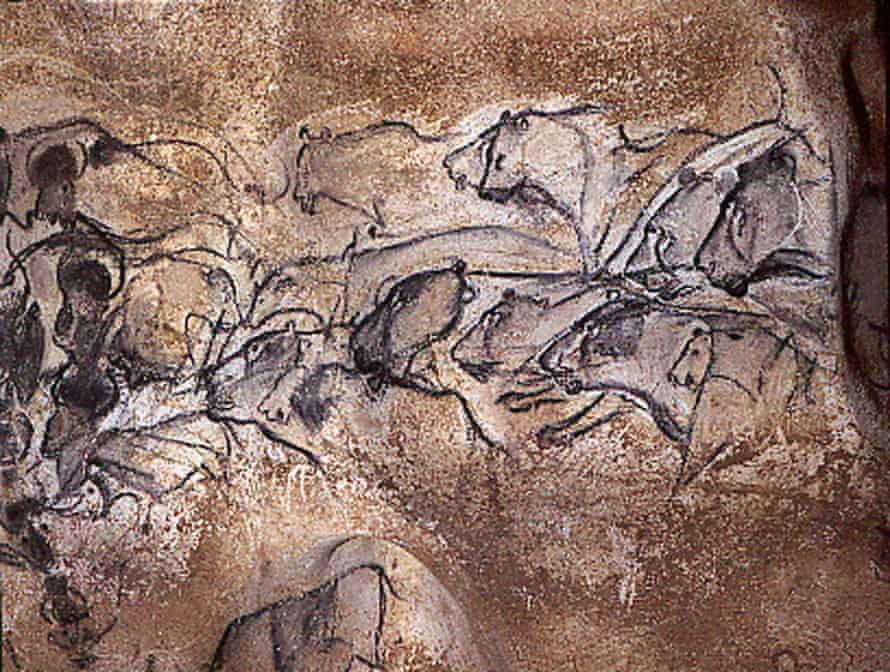
This was the famous and touristically magnetic Lascaux cavern, which eventually had to be closed to visitors lest their exhalations spoil the artwork. Today, nigh a century afterward, we know that Lascaux is office of a global phenomenon, originally referred to as "decorated caves". They accept been institute on every continent except Antarctica – at to the lowest degree 350 of them in Europe alone, cheers to the cave-rich Pyrenees – with the almost contempo discoveries in Kalimantan (2018) and Republic of croatia (April 2019). Uncannily, given the distances that separate them, all are adorned with like decorations: handprints or stencils of human hands, abstract designs containing dots and crosshatched lines, and big animals, both carnivores and herbivores, most of them now extinct. Not all of these images appear in each of the decorated caves – some feature but handprints or megafauna. Scholars of paleoarcheology infer that the paintings were made by our distant ancestors, although the caves comprise no depictions of humans doing whatever kind of painting.
There are homo-similar creatures, though, or what some archeologists charily call "humanoids", referring to the bipedal stick figures that can sometimes be found on the margins of the panels containing animal shapes. The non-human animals are painted with almost supernatural attending to facial and muscular item, but, no doubt to the disappointment of tourists, the humanoids painted on cave walls have no faces.
This struck me with unexpected force, no dubiety because of my ain detail historical situation, almost 20,000 years later the creation of the cave fine art in question. In almost 2002 we had entered the historic period of "selfies," in which everyone seemed fascinated past their electronic self-portraits – clothed or unclothed, fabricated-upward or natural, partying or pensive – and determined to propagate them as widely as possible. And then, in 2016, the United states of america acquired a president of whom the kindest thing that can be said is that he is a narcissist. This is a sloppily defined psychological condition, I acknowledge, but plumbing fixtures for a human then infatuated with his own image that he decorated the walls of his golf clubs with fake Fourth dimension magazine covers featuring himself. On top of all this, we have been served an eviction notice from our own planet: the polar regions are turning into meltwater. The residents of the southern hemisphere are pouring northward toward climates more hospitable to crops. In July, the temperature in Paris reached a tape-breaking 42.6C.
You could say that my sudden obsession with cave fine art was a pallid version of the boys' descent from Nazi-dominated France into the Lascaux cave. Articles in the New York Times urged distressed readers to have refuge in "cocky-intendance" measures such as meditation, nature walks and massages, but none of that appealed to me. Instead, I took intermittent breaks from what we presumed to telephone call "the Resistance" by throwing myself down the rabbit hole of paleoarcheological scholarship. In my example, information technology was not only a matter of escape. I constitute myself exhilarated past our comparatively ego-gratuitous ancestors, who went to great lengths, and depths, to create some of the world'southward most scenic art – and didn't even bother to sign their names.
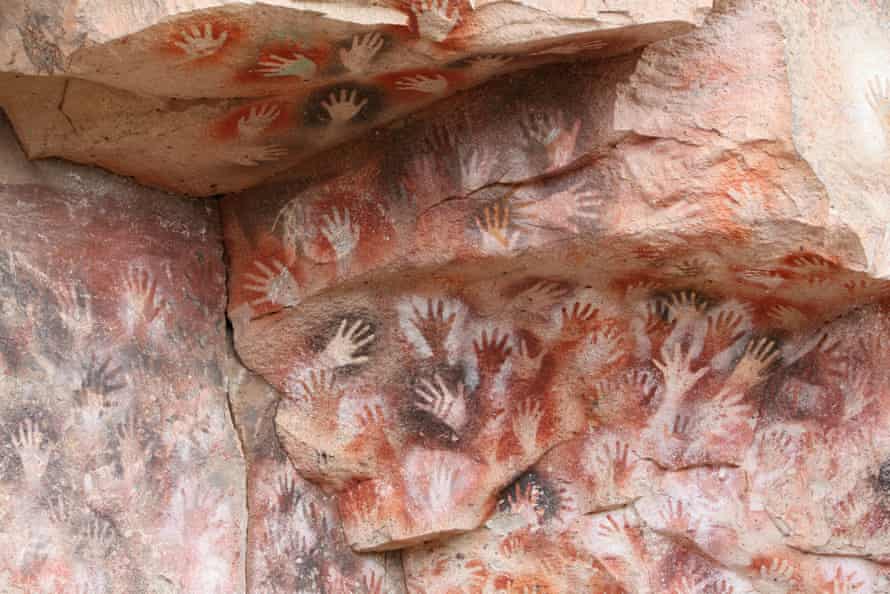
C ave art had a profound result on its 20th-century viewers, including the immature discoverers of Lascaux, at to the lowest degree ane of whom camped at the hole leading to the cave over the winter of 1940-41 to protect it from vandals, and perhaps Germans. More than illustrious visitors had like reactions. In 1928, the creative person and critic Amédée Ozenfant wrote of the art in the Les Eyzies caves, "Ah, those easily! Those silhouettes of hands, spread out and stencilled on an ochre footing! Go and see them. I promise you the nigh intense emotion you take ever experienced." He credited the Paleolithic artists with inspiring modern art, and to a sure caste, they did. Jackson Pollock honoured them by leaving handprints along the summit edge of at least ii of his paintings. Pablo Picasso reportedly visited the famous Altamira cavern earlier fleeing Spain in 1934, and emerged maxim: "Beyond Altamira, all is decadence."
Of form, cavern art also inspired the question raised by all truly absorbing art: "What does it hateful?" Who was its intended audience, and what were they supposed to derive from it? The male child discoverers of Lascaux took their questions to one of their schoolmasters, who roped in Henri Breuil, a priest familiar enough with all things prehistoric to be known every bit "the pope of prehistory". Unsurprisingly, he offered a "magico-religious" estimation, with the prefix "magico" serving as a slur to distinguish Paleolithic beliefs, whatsoever they may accept been, from the reigning monotheism of the modern world. More than practically, he proposed that the painted animals were meant to magically attract the actual animals they represented, the meliorate for humans to hunt and eat them.
Unfortunately for this theory, it turns out that the animals on cavern walls were not the kinds that the artists unremarkably dined on. The creators of the Lascaux art, for example, ate reindeer, non the much more formidable herbivores pictured in the cave, which would have been difficult for humans armed with flint-tipped spears to bring downwards without being trampled. Today, many scholars respond the question of meaning with what amounts to a shrug: "Nosotros may never know."
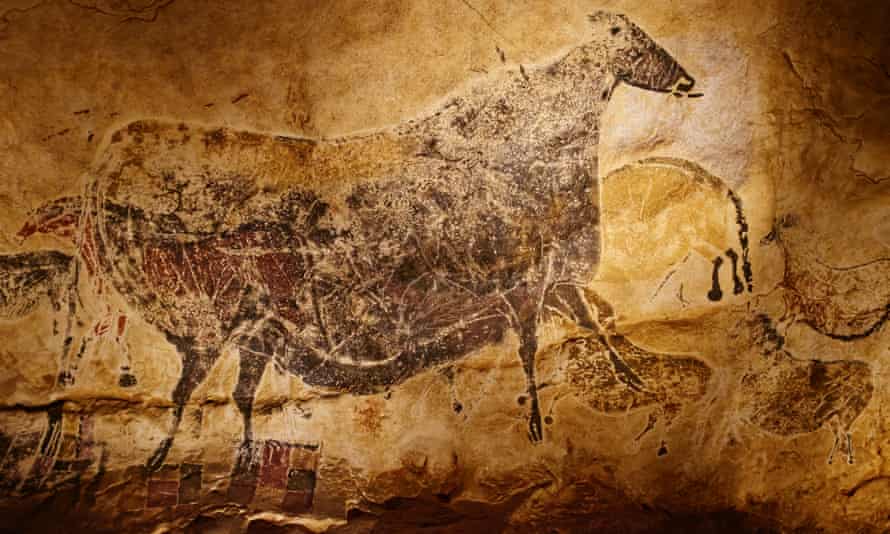
If sheer marvel, of the kind that drove the Lascaux discoverers, isn't enough to motivate a search for meliorate answers, at that place is a moral parable reaching out to united states of america from the cavern at Lascaux. Shortly after its discovery, the one Jewish male child in the group was apprehended and sent, along with his parents, to a detention center that served as a stop on the style to Buchenwald. Miraculously, he was rescued by the French Red Cross, emerging from captivity as possibly the only person on globe who had witnessed both the hellscape of xx-century fascism and the artistic remnants of the Paleolithic age. Every bit we know from the archeological tape, the latter was a time of relative peace among humans. No doubt there were homicides and tensions between and inside man bands, but it would be at to the lowest degree another 10,000 years before the invention of war as an organised collective activity. The cave fine art suggests that humans once had better means to spend their time.
If they were humans; and the worldwide gallery of known cave art offers and then few stick figures or bipeds of any kind that nosotros cannot be entirely sure. If the Paleolithic cave painters could create such perfectly naturalistic animals, why not give u.s.a. a glimpse of the painters themselves? Almost as strange as the absenteeism of human images in caves is the low level of scientific interest in their absenteeism. In his book What Is Paleolithic Art?, the world-class paleoarcheologist Jean Clottes devotes only a couple of pages to the issue, concluding that: "The essential part played past animals manifestly explains the small number of representations of human beings. In the Paleolithic world, humans were non at the centre of the stage." A paper published, oddly enough, by the US Centres for Illness Control and Prevention, expresses puzzlement over the omission of naturalistic depictions of humans, attributing information technology to Paleolithic people's "inexplicable fascination with wild fauna" (not that there were any non-wild animals around at the time).
The marginality of human figures in cavern paintings suggests that, at least from a human signal of view, the primal drama of the Paleolithic went on betwixt the various megafauna – carnivores and large herbivores. Then depleted of megafauna is our own world that it is hard to imagine how thick on the footing big mammals in one case were. Fifty-fifty the herbivores could be dangerous for humans, if mythology offers any clues: remember of the buffalo demon killed by the Hindu goddess Durga, or of the Cretan half-man, half-bull Minotaur, who could only exist subdued by circumscribed him to a labyrinth, which was, incidentally, a kind of cave. But as potentially edible herbivores such as aurochs (giant, now-extinct cattle) could be dangerous, expiry-dealing carnivores could exist inadvertently helpful to humans and their human-similar kin, for example, by leaving their half-devoured prey backside for humans to finish off. The Paleolithic landscape offered a lot of large animals to watch, and enough of reasons to continue a close eye on them. Some could exist eaten – after, for example, existence corralled into a trap by a band of humans; many others would readily consume humans.
Yet despite the catchy and life-threatening human relationship between Paleolithic humans and the megafauna that comprised so much of their surround, 20th-century scholars tended to claim cave art as evidence of an unalloyed triumph for our species. Information technology was a "great spiritual symbol", one famed fine art historian, himself an escapee from Nazism, proclaimed, of a time when "human had just emerged from a purely zoological existence, when instead of being dominated by animals, he began to boss them". But the stick figures found in caves such every bit Lascaux and Chauvet exercise non radiate triumph. By the standards of our own time, they are excessively self-effacing and, compared to the animals portrayed around them, pathetically weak. If these faceless creatures were actually smile in triumph, nosotros would, of course, have no way of knowing information technology.
W e are left with one tenuous inkling every bit to the cave artists' sense of their status in the Paleolithic universe. While archeologists tended to solemnise prehistoric art equally "magico-religious" or "shamanic," today'due south more secular viewers sometimes detect a vein of sheer silliness. For example, shifting to some other time and painting surface, India'south Mesolithic stone fine art portrays few human being stick figures; those that are portrayed have been described by mod viewers as "comical," "animalised" and "grotesque". Or consider the famed "birdman" image at Lascaux, in which a stick figure with a long, skinny erection falls backwards at the approach of a bison. As Joseph Campbell described it, operating from within the magico-religious image: "A large bison bull, eviscerated by a spear that has transfixed its anus and emerged through its sexual organ, stands before a prostrate human. The latter (the merely crudely drawn figure, and the but human being figure in the cave) is rapt in a shamanistic trance. He wears a bird mask; his phallus, erect, is pointing at the pierced balderdash; a throwing stick lies on the ground at his feet; and beside him stands a wand or staff, begetting on its tip the image of a bird. And then, backside this prostrate shaman, is a large rhinoceros, plain defecating equally it walks away."
Take out the words "shaman" and "shamanistic" and you have a description of a crude – very crude – interaction of a humanoid with two much larger and more than powerful animals. Is he, the humanoid, in a trance or only momentarily overcome by the force and beauty of the other animals? And what qualifies him as a shaman anyhow? The bird motif, which paleoanthropologists, cartoon on studies of extant Siberian cultures, automatically associated with shamanism? Similarly, a bipedal figure with a stag's head, found in the Trois Frères cave in France, is awarded shamanic status, making him or her a kind of priest, although, objectively speaking, they might as well exist wearing a party hat. As Judith Thurman wrote in the essay that inspired Werner Herzog's film The Cave of Forgotten Dreams, "Paleolithic artists, despite their penchant for naturalism, rarely chose to draw human beings, and then did so with a crudeness that smacks of mockery."
But who are they mocking, other than themselves and, by extension, their distant descendants, ourselves? Of course, our reactions to Paleolithic art may acquit no connection to the intentions or feelings of the artists. Still there are reasons to believe that Paleolithic people had a humour not all that unlike from our ain. Afterward all, nosotros exercise seem to share an artful sensibility with them, as evidenced past modern reactions to the gorgeous Paleolithic depictions of animals. Every bit for possible jokes, we have a geologist's 2018 report of a series of fossilised footprints institute in New Mexico. They are the prints of a giant sloth, with much smaller human footprints within them, suggesting that the humans were deliberately matching the sloth's stride and following it from a close distance. Practice for hunting? Or, as i science writer for The Atlantic suggested, is at that place "something almost playful" most the superimposed footprints, suggesting "a bunch of teenage kids harassing the sloths for kicks"?
Then there is the mystery of the exploding Venuses, where we once more encounter the thin line between the religious and the ridiculous. In the 1920s, in what is now the Czech republic, archeologists discovered the site of a Paleolithic ceramics workshop that seemed to specialise in carefully crafted little figures of animals and, intriguingly, of fat women with huge breasts and buttocks (although, consistent with the fashion of the times, no faces). These were the "Venuses," originally judged to be either "fertility symbols" or examples of Paleolithic pornography.
To the consternation of generations of researchers, the figures consisted nearly entirely of fragments. Shoddy craftsmanship, perhaps? An overheated kiln? Then, in 1989, an ingenious squad of archeologists figured out that the dirt used to brand the figurines had been deliberately treated and so that information technology would explode when tossed into a burn, creating what an art historian called a loud – and i would think, dangerous – brandish of "Paleolithic pyrotechnics." This, the Washington Post's account ended ominously, is "the earliest evidence that man created imagery only to destroy it".
Or we could expect at the behaviour of extant stone age people, which is by no ways a reliable guide to that of our afar ancestors, just may contain clues as to their comical abilities. Evolutionary psychiatrists point out that anthropologists contacting previously isolated peoples such every bit 19th-century Indigenous Australians found them joking in ways comprehensible even to anthropologists. Furthermore, anthropologists report that many of the remaining hunter-gatherers are "fiercely egalitarian", deploying humour to subdue the ego of anyone who gets out of line: "Yes, when a swain kills much meat he comes to recall of himself every bit a master or a large human, and he thinks of the residual of us equally his servants or inferiors," 1 Kalahari hunter told the anthropologist Richard B Lee in 1968. "We can't take this. We reject ane who boasts, for anytime his pride volition brand him impale somebody. So we always speak of his meat as worthless. This way nosotros cool his middle and make him gentle."
Some lucky hunters don't look to exist ridiculed, choosing instead to disparage the meat they have acquired as soon as they arrive back at camp. In the context of a shut-knit human group, self-mockery can be self-protective.
In the Paleolithic historic period, humans were probably less concerned about the opinions of other humans than with the actions and intentions of the far more numerous megafauna around them. Would the herd of bison stop at a certain watering hole? Would lions show up to set on them? Would it be safe for humans to grab at whatever scraps of bison were left over from the lions' meal? The vein of silliness that seems to run through Paleolithic art may grow out of an authentic perception of humans' place in the earth. Our ancestors occupied a lowly spot in the food chain, at least compared to the megafauna, but at the same time they were capable of understanding and depicting how lowly it was. They knew they were meat, and they likewise seemed to know that they knew they were meat – meat that could think. And that, if you think nearly information technology long enough, is about funny.
P aleolithic people were definitely capable of depicting more realistic humans than stick figures – homo figures with faces, muscles and curves formed by pregnancy or fat. Tiles constitute on the floor of the La Marche cave in French republic are etched with distinctive faces, some topped with caps, and take been dated to 14-15,000 years agone. A solemn, oddly triangular, female face carved in ivory was found in tardily 19th-century French republic and recently dated to about 24,000 years ago. Then there are the above mentioned "Venus" figurines plant scattered about Eurasia from near the same fourth dimension. But all these are small and were apparently meant to be carried around, like amulets, maybe – as cavern paintings apparently could not exist. Cavern paintings stay in their caves.
What is information technology virtually caves? The attraction of caves as art studios and galleries does not stem from the fact that they were convenient for the artists. In fact, there is no evidence of continuous human being home in the decorated caves, and certainly none in the deepest, hardest-to-access crannies reserved for the about spectacular brute paintings. Cave artists are not to exist confused with "cavemen".
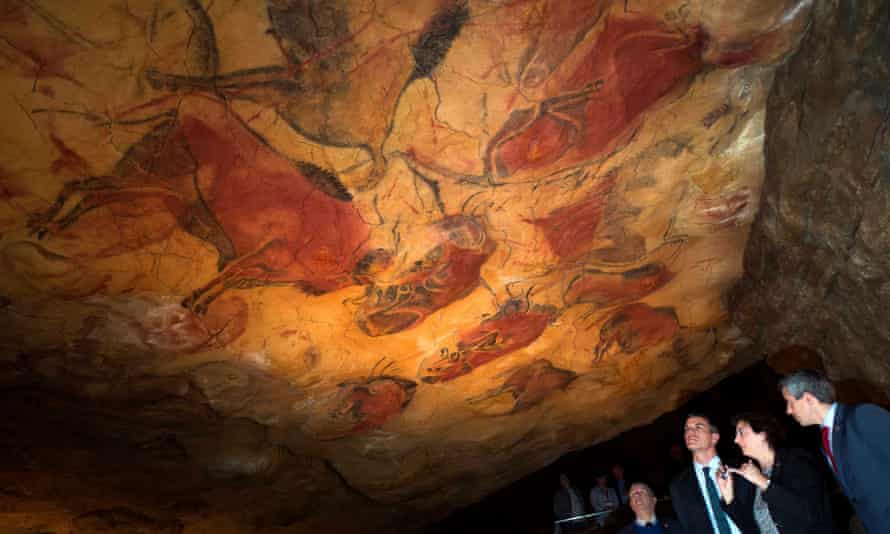
Nor do we need to posit whatever special human affinity for caves, since the fine art they contain came downwards to united states of america through a simple procedure of natural selection: outdoor art, such equally figurines and painted rocks, is exposed to the elements and unlikely to last for tens of thousands of years. Paleolithic people seem to have painted all kinds of surfaces, including leather derived from animals, as well as their ain bodies and faces, with the same kinds of ochre they used on cave walls. The difference is that the paintings on cave walls were well enough protected from rain and wind and climate change to survive for tens of millennia. If in that location was something special well-nigh caves, information technology was that they are ideal storage lockers. "Caves," as paleoarcheologist April Nowell puts information technology, "are funny little microcosms that protect pigment."
If the painters of Lascaux were enlightened of the preservative properties of caves, did they anticipate future visits to the same site, either by themselves or others? Earlier the intrusion of civilisation into their territories, hunter-gatherers were "non-sedentary" people – perpetual wanderers. They moved to follow seasonal animal migrations and the ripening of fruits, probably even to escape from the human being faeces that inevitably piled upward effectually their campsites. These smaller migrations, reinforced past intense and oscillating climate modify in the Horn of Africa, added up to the prolonged exodus from that continent to the Arabian peninsula and hence to the rest of the world. With so much churning and relocating going on, it'due south possible that Paleolithic people could conceive of returning to a decorated cave or, in an even greater leap of the imagination, foresee visits by others like themselves. If so, the cave art should be thought of as a sort of difficult drive, and the paintings equally data – and not simply "Here are some of the animals yous will encounter around here," just also "Here nosotros are, creatures like yourselves, and this is what we know."
Multiple visits by different groups of humans, perhaps over long periods of time, could explain the strange fact that, as the intrepid French boys observed, the animals painted on cave walls seem to be moving. There is nothing supernatural at work hither. Look closely, and you encounter that the beast figures are usually equanimous of superimposed lines, suggesting that new arrivals in the cavern painted over the lines that were already there, more or less like children learning to write the messages of the alphabet. Then the cave was non only a museum. It was an art school where people learned to paint from those who had come before them, and went on to apply their skills to the side by side suitable cave they came across. In the process, and with some help from flickering lights, they created blitheness. The move of bands of people across the mural led to the apparent motility of animals on the cave walls. As humans painted over older artwork, moved on, and painted again, over tens of thousands of years, cavern fine art – or, in the absence of caves, rock fine art – became a global meme.
There is something else well-nigh caves. Not merely were they storage spaces for precious artwork, they were likewise gathering places for humans, peradventure up to 100 at a fourth dimension in some of the larger chambers. To paleoanthropologists, especially those leaning toward magico-religious explanations, such spaces inevitably suggest rituals, making the decorated cave a kind of cathedral within which humans communed with a higher power. Visual art may take been only one part of the uplifting spectacle; recently, much attention has been paid to the acoustic properties of busy caves and how they may have generated awe-inspiring reverberant sounds. People sang, chanted or drummed, stared at the lifelike animals around them, and peradventure got high: the cave every bit an platonic venue for a rave. Or maybe they took, say, psychedelic mushrooms they plant growing wild, then painted the animals, a possibility suggested past a few modernistic reports from San people in southern Africa, who dance themselves into a trance state before getting downwards to piece of work.
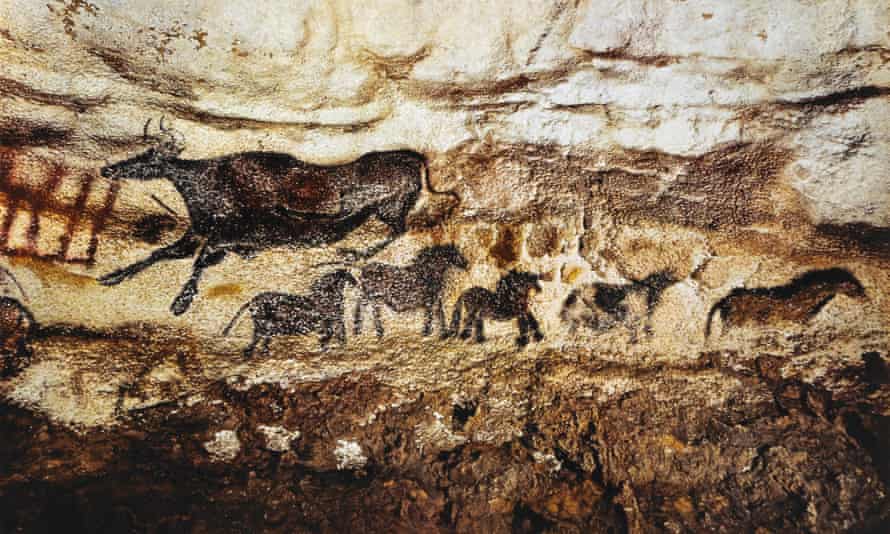
Each ornament of a new cave, or redecoration of an old one, required the collective endeavour of tens or possibly scores of people. Twentieth-century archeologists liked to imagine they were seeing the piece of work of especially talented individuals – artists or shamans. But as Gregory Curtis points out in his book The Cavern Painters, information technology took a crowd to decorate a cave – people to inspect the cave walls for cracks and protuberances suggestive of megafauna shapes, people to haul logs into the cave to construct the scaffolding from which the artists worked, people to mix the ochre paint, and still others to provide the workers with nutrient and water. Careful assay of the handprints found in so many caves reveals that the participants included women and men, adults and children. If cave art had a office other than preserving information and enhancing ecstatic rituals, it was to teach the value of cooperation, which – to the point of self-sacrifice – was essential for both communal hunting and collective defence.
In his book Sapiens, Yuval Noah Harari emphasises the importance of commonage effort in the evolution of modern humans. Individual skill and courage helped, but so did the willingness to stand with i'southward band: not to scatter when a dangerous animal approached, not to climb a tree and leave the babe backside. Maybe, in the e'er-challenging context of an animal-dominated planet, the demand for human solidarity so far exceeded the need for individual recognition that, at least in creative representation, humans didn't need faces.
A ll this cave painting, migrating and repainting came to an end roughly 12,000 years agone, with what has been applauded equally the "Neolithic revolution". Defective pack animals and maybe tired of walking, humans began to settle downward in villages, and eventually walled cities; they invented agronomics and domesticated many of the wild animals whose ancestors had figured so prominently in cave art. They learned to weave, brew beer, smelt ore and craft e'er-sharper blades.
But whatever comforts sedentism brought came at a terrible price: property, in the form of stored grain and edible herds, segmented societies into classes – a procedure anthropologists prudently term "social stratification"– and seduced humans into warfare. State of war led to the establishment of slavery, especially for the women of the defeated side (defeated males were usually slaughtered) and stamped the entire female person gender with the stigma attached to concubines and domestic servants. Men did better, or at to the lowest degree a few of them, with the most outstanding commanders rising to the status of kings and eventually emperors. Wherever sedentism and agriculture took hold, from China to South and Cardinal America, coercion past the powerful replaced cooperation among equals. In Jared Diamond's blunt assessment, the Neolithic revolution was "the worst mistake in the history of the human race".
At least it gave us faces. Starting with the implacable "mother goddesses" of the Neolithic Heart East, and moving on to the sudden proliferation of kings and heroes in the Bronze Age, the emergence of human being faces seems to mark a characterological change – from the solidaristic ethos of small, migrating bands to what we now know as narcissism. Kings and occasionally their consorts were the get-go to savour the new marks of personal superiority – crowns, jewellery, masses of slaves, and the arrogance that went forth with such things. Over the centuries, narcissism spread downwardly to the suburbia, who, in 17th-century Europe, were kickoff to write memoirs and commission their ain portraits. In our ain time, anyone who tin can beget a smartphone tin can propagate their ain image, publish their nearly fleeting thoughts on social media and burnish their unique brand. Narcissism has been democratised and is bachelor, at to the lowest degree in crumb-sized morsels, to us all.
Then what exercise we need decorated caves for any more? 1 agonizing possible use for them has arisen in just the last decade or then – as shelters to hide out in until the apocalypse blows over. With the seas rise, the weather turning into a series of psychostorms, and the earth's poor condign ever more restive, the super-rich are ownership upwards abandoned nuclear silos and converting them into doomsday bunkers that tin can business firm up to a dozen families, plus guards and servants, at a time. These are simulated caves of course, but they are wondrously outfitted – with pond pools, gyms, shooting ranges, "outdoor" cafes – and decorated with precious artworks and huge LED screens displaying what remains of the outside world.
But it's the Paleolithic caves we need to return to, and not just because they are yet capable of inspiring transcendent experiences and connecting united states with the long-lost natural world. We should be drawn back to them for the bulletin they have reliably preserved for more than 10,000 generations. Granted, information technology was not intended for us, this message, nor could its authors take imagined such perverse and self-destructive descendants as we have get. Simply it's in our easily now, still illegible unless we push back hard against the artificial dividing line betwixt history and prehistory, hieroglyphs and petroglyphs, between the "primitive" and the "advanced." This will take all of our skills and knowledge – from art history to uranium-thorium dating techniques to best practices for international cooperation. But it will be worth the effort, because our Paleolithic ancestors, with their faceless humanoids and capacity for silliness, seem to take known something we strain to imagine.
They knew where they stood in the scheme of things, which was non very loftier, and this seems to accept fabricated them laugh. I strongly suspect that we will not survive the mass extinction we have prepared for ourselves unless we likewise finally get the joke.
This commodity commencement appeared in the Baffler magazine
Source: https://www.theguardian.com/artanddesign/2019/dec/12/humans-were-not-centre-stage-ancient-cave-art-painting-lascaux-chauvet-altamira
0 Response to "human Images in the Paleo Lithic Art of Eurasia"
Post a Comment