What Is Young Female Beef Called What Is Castrated Beef
Castration is 'removal of the testicles' in very young male cattle. Still some of the techniques used to 'castrate' bull calves in Australia do not involve bodily removal of the testicles.
Castration is carried out for the following reasons:
- Prevention of undesirable balderdash calves from convenance. This enables mating of bulls just with desirable traits.
- Behavioural control. Castrated male person cattle (steers) are generally less ambitious and easier to handle, are less likely to fight causing injury to other animals, and are less likely to damage fences.
- The secondary sex characteristics of bulls tend to brand balderdash meat tougher and less bonny to consumers, especially for the college priced cuts.
The disadvantages of castration are modest in comparing to the advantages gained. Removal of the testicles before puberty will reduce the growth rate of the calf. This is because the testicles produce hormones as well every bit spermatozoa. The major hormone produced by the testicles is testosterone, more commonly referred to as male person hormone. Testosterone has an anabolic action – it promotes muscle growth.
Castration should be carried out on bull calves when they are very immature, and certainly before half dozen months of age. On larger properties with large numbers of breeding females this may be difficult to achieve, peculiarly if calves are born at the start of the wet season (as recommended) or just subsequently the last muster the previous year.
Methods of castration
With all methods of castration constructive restraint (i.e. calf cradle) is essential for the welfare of the dogie and the operator. Whether performing surgical or non surgical castration it is important to disinfect equipment in an antiseptic solution, between animals, and have a split bucket of antiseptic for washing hands. Information about options for pain relief during castration tin be establish at Pain relief medication for beef cattle.
Surgical
This is the nigh commonly used method of castration in Australia.
An incision is made at the lesser of the scrotum using a scalpel blade to betrayal the testicle. In some cases the testicles proper may yet be hidden behind a thick whitish membrane – the tunica vaginalis. If this is the case it will be necessary to make an incision in the tunica to completely expose the testicle. A deep initial incision ensures the testicle is exposed immediately. The attached ligaments and vas deferens (sperm string) can be separated from the testicle with the fingers and/or blade.
The testicle can be removed by pulling on the exposed testicle (this is less suitable for older calves) or by rubbing the sharp bract sideways on the exposed string to scrape the blood vessels. Do not make a clean abrupt incision of the string as this may lead to excessive bleeding. The near desirable method is to remove the exposed testicle using triple crush emasculators which crushes and cuts the blood vessels and hence minimises haemorrhage. Emasculators are the preferred choice for older calves and for castrations washed in hotter weather.
Proficient hygiene is essential when castrating. It is preferable that the scalpel and emasculators are soaked in disinfectant betwixt operations and that the disinfectant is changed after every 20 animals. Poor hygiene may lead to infection which delays healing and may set back growth. Fly command should be considered at sure times of the year. Calves should exist vaccinated confronting tetanus.
Elastrator rings
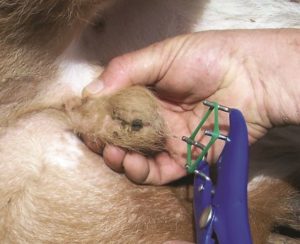 An elastrator ring placed to a higher place the cervix of the scrotum volition cut off all claret vessels and subsequently a catamenia of time (ordinarily three to vi weeks) lead to that part of the scrotum and its contents (mainly the testicles) dropping off.
Some cattle breeders prefer this method considering information technology is a non-invasive method of castration. Another advantage of elastrator rings is that trivial or (ordinarily) no bleeding occurs. There is no scientific evidence that use of elastrator rings reduces contamination by tetanus or other organisms.
Because the elastrator rings are designed and made for use on sheep, they are by and large only able to be used on smaller calves. It is hard to place the ring in a higher place the testicles of larger animals. The Australian Code of Practice for the Welfare of Animals states that elastrator rings are but suitable for calves under two weeks of age.
Burdizzo (Bloodless castration pincers)
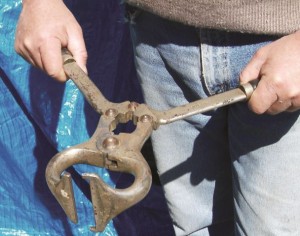 Burdizzo is the trade name for an Italian made bloodless castration pincers. The primary of operation is similar to that of the elastrator ring. If used correctly the blood vessels and spermatic cord are meant to be irreparably crushed, thus stopping blood supply preventing testicle growth and part. Within six weeks atrophy of the testicles should be complete.
This technique is successful when used by experienced operators. Due to risk of failure it is not recommended for use by inexperienced operators. There appears to be less hurting and there is reduced risk of infection as the wound is non open.
The Burdizzo has the advantage of elastrator rings in that it is non-invasive and causes no bleeding. Unlike elastrator rings information technology tin can exist used on older animals. However the Australian Code of Practise for the Welfare of Animals states that this method should only be used on calves under six months of age if washed without anaesthetic.
This information is simply intended every bit a brief overview of castration methods. To learn more near castration and correct castration technique recommended reading is A guide to best do husbandry in beef cattle: branding, castrating and dehorning (PDF, 3MB), a gratis Meat & Livestock Commonwealth of australia publication.
Dennis Boothby, formerly Queensland Regime.
Source: https://futurebeef.com.au/resources/castration/
0 Response to "What Is Young Female Beef Called What Is Castrated Beef"
Post a Comment