Which 2 Examples of Supporting Families During Transition Is the Most Effective and Why?
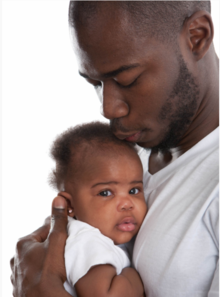
A father holds his child.
Parenting or child rearing promotes and supports the physical, emotional, social, and intellectual evolution of a child from infancy to adulthood. Parenting refers to the intricacies of raising a child and non exclusively for a biological relationship.[1]
The about common flagman in parenting is the begetter or mother, or both, the biological parents of the child in question. However, a surrogate may exist an older sibling, a step-parent, a grandparent, a legal guardian, aunt, uncle, other family unit members, or a family unit friend.[2] Governments and society may besides accept a role in child-rearing. In many cases, orphaned or abased children receive parental intendance from not-parent or non-blood relations. Others may be adopted, raised in foster intendance, or placed in an orphanage. Parenting skills vary, and a parent or surrogate with skilful parenting skills may be referred to every bit a good parent.[three]
Parenting styles vary past historical period, race/ethnicity, social class, preference, and a few other social features.[4] Additionally, research supports that parental history, both in terms of attachments of varying quality and parental psychopathology, particularly in the wake of adverse experiences, can strongly influence parental sensitivity and kid outcomes.[v] [6] [7]
Factors that touch decisions [edit]
Social grade, wealth, culture and income have a very stiff affect on what methods of child rearing parents use.[8] Cultural values play a major role in how a parent raises their child. Even so, parenting is always evolving, every bit times, cultural practices, social norms, and traditions change. Studies on these factors affecting parenting decisions accept shown just that.[9] [10]
In psychology, the parental investment theory suggests that basic differences between males and females in parental investment have great adaptive significance and lead to gender differences in mating propensities and preferences.[eleven]
A family's social class plays a big office in the opportunities and resource that will be available to a kid. Working-form children often grow upwards at a disadvantage with the schooling, communities, and level of parental attending available compared to those from the middle-class or upper-class.[12] Also, lower working-course families do not get the kind of networking that the centre and upper classes do through helpful family members, friends, and community individuals or groups also as various professionals or experts.[13]
Styles [edit]
A parenting way is indicative of the overall emotional climate in the home.[14] Developmental psychologist Diana Baumrind identified 3 principal parenting styles in early kid evolution: administrative, disciplinarian, and permissive.[15] [16] [17] [xviii] [ excessive citations ] These parenting styles were afterward expanded to iv to include an uninvolved style. These 4 styles involve combinations of acceptance and responsiveness, and as well involve demand and control.[19] Research[20] has found that parenting mode is significantly related to a kid's subsequent mental health and well-being. In detail, administrative parenting is positively related to mental health and satisfaction with life, and authoritarian parenting is negatively related to these variables.[21] With authoritarian and permissive parenting on contrary sides of the spectrum, nigh conventional modern models of parenting fall somewhere in between.
- Administrative parenting
- Described by Baumrind as the "just right" way, it combines medium level demands on the child and a medium level responsiveness from the parents. Administrative parents rely on positive reinforcement and infrequent utilise of penalisation. Parents are more than aware of a child's feelings and capabilities and support the evolution of a child's autonomy within reasonable limits. At that place is a give-and-take atmosphere involved in parent-child advice, and both control and support are balanced. Some research[ vague ]has shown that this style of parenting is more beneficial than the as well-hard authoritarian style or the too-soft permissive mode.[22] This parenting fashion results from successful, and happy children. When proficient without physical punishment, one gets the most favorable results with the to the lowest degree issues in today's globe. These children score higher in terms of competence, mental wellness, and social development than those raised in permissive, authoritarian, or neglectful homes.[23]
- Authoritarian parenting styles
- Authoritarian parents are very rigid and strict. Loftier demands are placed on the child, only there is little responsiveness to them. Parents who practice disciplinarian-style parenting have a non-negotiable set of rules and expectations strictly enforced and require rigid obedience. When the rules are non followed, punishment is often used to promote and ensure future compliance.[24] In that location is commonly no explanation of punishment except that the child is in trouble for breaking a rule.[24] This parenting fashion is strongly associated with corporal punishment, such as spanking. A typical response to a child'due south question of authority would be, "because I said and so." This type of parenting seems to be seen more oft in working-class families than in the middle class.[25] [26] In 1983, Diana Baumrind constitute that children raised in an authoritarian-style home were less cheerful, moodier, and more vulnerable to stress. In many cases, these children also demonstrated passive hostility. This parenting style can negatively impact the educational success and career path, while a firm and reassuring parenting style impact positively.[27]
- Permissive parenting
- Permissive parenting has become a more popular parenting method for middle-course families than working-grade families roughly since the end of WWII.[28] In these settings, a kid'southward freedom and autonomy are highly valued, and parents rely primarily on reasoning and caption. Parents are undemanding, and thus at that place tends to be petty if any punishment or explicit rules in this parenting style. These parents say that their children are free from external constraints and tend to be highly responsive to whatever it is that the child wants. Children of permissive parents are generally happy only sometimes show low levels of cocky-control and cocky-reliance because they lack structure at home.[29]
- Uninvolved parenting
- An uninvolved or neglectful parenting style is when parents are often emotionally or physically absent-minded.[thirty] They take little to no expectations from the kid and regularly take no communication. They are not responsive to a child'due south needs and have little to no behavioral expectations. If nowadays, they may provide what the kid needs for survival with fiddling to no engagement.[thirty] There is often a large gap betwixt parents and children with this parenting manner.[ vague ] Children with little or no communication with their own parents tend to exist victimized by other children and may exhibit deviant behavior themselves.[31] Children of uninvolved parents suffer in social competence, academic performance, psychosocial development, and problematic behavior.
Practices [edit]

A parenting do is a specific behavior that a parent uses in raising a child.[14] For instance, many parents read aloud to their offspring in the hopes of supporting their linguistic and intellectual evolution. In cultures with strong oral traditions, such as Indigenous American communities, storytelling is a disquisitional parenting practice for children.[32]
Parenting practices reflect the cultural agreement of children.[33] Parents in individualistic countries similar Frg spend more than fourth dimension engaged in face-to-face interaction with babies and more time talking to the babe about the baby. Parents in more than communal cultures, such as West African cultures, spend more time talking to the babe almost other people and more than time with the baby facing outwards so that the baby sees what the mother sees.[33]
Skills and Behaviors [edit]
Parenting skills and behaviors assist parents in leading children into healthy machismo and development of the child'due south social skills. The cognitive potential, social skills, and behavioral functioning a kid acquires during the early on years are positively correlated with the quality of their interactions with their parents.[34]
According to the Canadian Quango on Learning, children benefit (or avoid poor developmental outcomes) when their parents:
- Communicate truthfully about events: Authenticity from parents who explain tin can aid their children understand what happened and how they are involved;
- Maintain consistency: Parents that regularly establish routines tin can see benefits in their children's behavioral patterns;
- Utilize resources available to them, reaching out into the community and building a supportive social network;
- Take an interest in their child's educational and early on developmental needs (e.g., Play that enhances socialization, autonomy, cohesion, calmness, and trust.); and
- Keep open communication lines about what their child is seeing, learning, and doing, and how those things are affecting them.[ citation needed ]
Parenting skills are widely idea to be naturally present in parents; notwithstanding, there is substantial testify to the contrary. Those who come up from a negative or vulnerable babyhood surround ofttimes (and oftentimes unintentionally) mimic their parents' behavior during interactions with their own children. Parents with an inadequate understanding of developmental milestones may also demonstrate problematic parenting. Parenting practices are of item importance during marital transitions similar separation, divorce, and remarriage;[35] if children fail to fairly adjust to these changes, they are at adventure of negative outcomes (e.g. increased rule-breaking behavior, issues with peer relationships, and increased emotional difficulties).[36]
Research classifies competence and skills required in parenting as follows:[37]
- Parent-child human relationship skills: quality time spent, positive communications, and delighted prove of affection.
- Encouraging desirable beliefs: praise and encouragement, nonverbal attending, facilitating engaging activities.
- Education skills and behaviors: being a good example, incidental instruction, human being advice of the skill with role-playing and other methods, communicating logical incentives and consequences.
- Managing misbehavior: establishing firm ground rules and limits, directing discussion, providing articulate and calm instructions, communicating and enforcing appropriate consequences, using restrictive tactics like quiet time and time out with an authoritative opinion rather than an authoritarian one.
- Anticipating and planning: advanced planning and preparation for readying the kid for challenges, finding out engaging and age-appropriate developmental activities, preparing the token economy for self-management practice with guidance, holding follow-up discussions, identifying possible negative developmental trajectories.
- Self-regulation skills: monitoring behaviors (own and children's),[38] setting developmentally appropriate goals, evaluating strengths and weaknesses and setting practice tasks, monitoring and preventing internalizing and externalizing behaviors.
- Mood and coping skills: reframing and discouraging unhelpful thoughts (diversions, goal orientation, and mindfulness), stress and tension management (own and children's), developing personal coping statements and plans for high-risk situations, edifice common respect and consideration betwixt members of the family through collaborative activities and rituals.
- Partner back up skills: improving personal communication, giving and receiving constructive feedback and back up, avoiding negative family interaction styles, supporting and finding promise in issues for adaptation, leading collaborative problem solving, promoting human relationship happiness and cordiality.
Consistency is considered the "backbone" of positive parenting skills and "overprotection" the weakness.[39]
Parent training [edit]
Parent psychosocial health can have a significant bear on on the parent-child relationship. Group-based parent training and pedagogy programs accept proven to be effective at improving short-term psychosocial well-being for parents.There are many different types of training parents tin can have to support their parenting skills. Courses are offered to families based on constructive training to support boosted needs, behavioral guidelines, communication and many others to give guidance throughout learning how to exist a parent.[40]
Cultural values [edit]
Parents around the world want what they believe is best for their children. All the same, parents in different cultures have different ideas of what is all-time.[41] For instance, parents in hunter–gatherer societies or those who survive through subsistence agronomics are likely to promote practical survival skills from a young historic period. Many such cultures begin teaching children to use sharp tools, including knives, before their outset birthdays.[42] In some Indigenous American communities, child work provides children the opportunity to absorb cultural values of collaborative participation and prosocial behavior through observation and activeness aslope adults.[43] These communities value respect, participation, and non-interference, the Cherokee principle of respecting autonomy by withholding unsolicited advice.[44] Indigenous American parents also try to encourage curiosity in their children via a permissive parenting style that enables them to explore and acquire through observation of the world.[45]
Differences in cultural values cause parents to interpret the same behaviors in dissimilar means.[41] For example, European Americans prize intellectual agreement, especially in a narrow "book learning" sense, and believe that asking questions is a sign of intelligence. Italian parents value social and emotional competence and believe that curiosity demonstrates good interpersonal skills.[41] Dutch parents, however, value independence, long attention spans, and predictability; in their eyes, asking questions is a negative behavior, signifying a lack of independence.[41]
All the same, parents around the earth share specific prosocial behavioral goals for their children. Hispanic parents value respect and emphasize putting family unit above the individual. Parents in Eastern asia prize guild in the household to a higher place all else. In some cases, this gives rise to high levels of psychological control and even manipulation on the part of the head of the household.[46] The Kipsigis people of Republic of kenya value children who are innovative and wield that intelligence responsibly and helpfully—a behavior they call ng/om.[41] Other cultures, such equally Sweden and Spain, value sociable and happiness also.[41]
Indigenous American cultures [edit]

Baby on back in Lima, Peru
It is common for parents in many Indigenous American communities to use different parenting tools such as storytelling —like myths— Consejos (Spanish for "advice"), educational teasing, nonverbal communication, and observational learning to teach their children important values and life lessons.
Storytelling is a way for Indigenous American children to learn most their identity, community, and cultural history. Indigenous myths and sociology often personify animals and objects, reaffirming the belief that everything possesses a soul and deserves respect. These stories also aid preserve the language and are used to reflect sure values or cultural histories.[47]
The Consejo is a narrative form of advice-giving. Rather than directly telling the child what to practise in a item situation, the parent might instead tell a story nigh a like situation. The main character in the story is intended to help the child run into their decision's implications without direct deciding for them; this teaches the child to be decisive and independent while still providing some guidance.[48]
The playful form of teasing is a parenting method used in some Indigenous American communities to keep children out of danger and guide their behavior. This parenting strategy utilizes stories, fabrications, or empty threats to guide children in making safe, intelligent decisions. For example, a parent may tell a child that there is a monster that jumps on children'southward backs if they walk alone at night. This explanation can help go on the child safety because instilling that fear creates greater awareness and lessens the likelihood that they will wander alone into problem.[49]
In Navajo families, a child'southward development is partly focused on the importance of "respect" for all things. "Respect" consists of recognizing the significance of 1's human relationship with other things and people in the world. Children largely learn well-nigh this concept via nonverbal communication betwixt parents and other family unit members.[50] For instance, children are initiated at an early on age into the practice of an early on morning run nether any weather weather. On this run, the community uses humor and laughter with each other, without directly including the kid—who may not wish to get upward early on and run—to encourage the kid to participate and become an agile fellow member of the community.[l] Parents likewise promote participation in the morning runs past placing their kid in the snow and having them stay longer if they protest.[l]
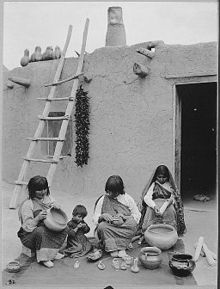
Indians of Santa Clara Pueblo, New Mexico, making pottery, 1916
Indigenous American parents oft incorporate children into everyday life, including adult activities, allowing the kid to learn through observation. This practice is known as LOPI, Learning by Observing and Pitching In, where children are integrated into all types of mature daily activities and encouraged to observe and contribute in the community. This inclusion every bit a parenting tool promotes both community participation and learning.[51]
One notable example appears in some Mayan communities: immature girls are not permitted around the hearth for an extended period of time, since corn is sacred. Although this is an exception to their cultural preference for incorporating children into activities, including cooking, it is a strong example of observational learning. Mayan girls can just watch their mothers making tortillas for a few minutes at a fourth dimension, but the sacredness of the activity captures their interest. They will and then go and exercise their mother's movements on other objects, such as kneading thin pieces of plastic like a tortilla. From this exercise, when a girl comes of age, she is able to sit downward and make tortillas without having ever received whatever explicit exact instruction.[52]
[edit]
Due to the increasing racial and ethnic diversity in the United States, ethnic-racial socialization inquiry has gained some attention.[53] Parental indigenous-racial socialization is a mode of passing down cultural resource to support children of color's psychosocial health.[53] The goals of indigenous-racial socialization are: to pass on a positive view of one'due south ethnic grouping and to help children cope with racism.[53] Through a meta-analysis of published research on ethnic-racial socialization, indigenous-racial socialization positively affects psychosocial well-being.[53] This meta-analytic review focuses on inquiry relevant to iv indicators of psychosocial skills and how they are influenced by developmental stage, race and ethnicity, inquiry designs, and the differences between parent and child cocky-reports.[53] The dimensions of ethnic-racial socialization that are considered when looking for correlations with psychosocial skills are cultural socialization, training for bias, promotion of mistrust, and egalitarianism.[53]
Ethnic-racial socialization dimensions are divers every bit follows: cultural socialization is the process of passing down cultural customs, preparation for bias ranges from positive or negative reactions to racism and discrimination, promotion of mistrust conditions synergy when dealing with other races, and egalitarianism puts similarities between races first.[53] Psychosocial competencies are defined equally follows: cocky-perceptions involve perceived beliefs of bookish and social capabilities, interpersonal relationships deal with the quality of relationships, externalizing behaviors deal with observable troublesome behavior, and internalizing behavior deals with emotional intelligence regulation.[53] The multiple ways these domains and competencies interact show small-scale correlations betwixt ethnic-racial socialization and psychosocial health, but this parenting do needs further inquiry.[53]
This meta-analysis showed that developmental stages bear on how children perceived ethnic-racial socialization.[53] Cultural socialization practices appear to affect children similarly across developmental stages except for preparation for bias and promotion of mistrust which are encouraged for older-anile children.[54] [55] [56] Existing research shows ethnic-racial socialization serves African Americans positively against discrimination.[56] Cross-sectional studies were predicted to have greater result sizes because correlations are inflated in these kinds of studies.[57] [58] [59] Parental reports of ethnic-racial socialization influence are influenced by "intentions," so child reports tend to be more than authentic.[59]
Among other conclusions derived from this meta-analysis, cultural socialization and self-perceptions had a minor positive correlation. Cultural socialization and promotion of mistrust had a minor negative correlation, and interpersonal relationships positively impacted cultural socialization and preparation for bias.[53] In regard to developmental stages, indigenous-racial socialization had a pocket-size but positive correlation with self-perceptions during childhood and early adolescence.[53] Based on written report designs, there were no significant differences, meaning that cross-sectional studies and longitudinal studies both showed small positive correlations between ethnic-racial socialization and cocky-perceptions.[53] Reporter differences between parents and children showed positive correlations between ethnic-racial socialization when associated with internalizing beliefs and interpersonal relationships.[53] These two correlations showed a greater outcome size with child reports compared to parent reports.[53]
The meta-analysis on previous research shows just correlations, so at that place is a need for experimental studies that can evidence causation amongst the different domains and dimensions.[53] Children'southward behavior and accommodation to this beliefs may indicate a bidirectional effect that can also be addressed by an experimental study.[53] There is evidence to show that ethnic-racial socialization can help children of color obtain social-emotional skills that can help them navigate through racism and bigotry, but further research needs to be done to increase the generalizability of existing research.[53]
Across the lifespan [edit]
Pre-pregnancy [edit]
Family planning is the conclusion-making procedure surrounding whether or non and when to become parents, including planning, preparing, and gathering resources. Prospective parents may assess (amongst other matters) whether they accept admission to sufficient fiscal resources, whether their family situation is stable, and whether they want to undertake the responsibility of raising a kid. Worldwide, almost 40% of all pregnancies are not planned, and more than than 30 million babies are born each yr every bit a outcome of unplanned pregnancies.[60]
Reproductive health and preconception care impact pregnancy, reproductive success, and the physical and mental health of both mother and kid. A woman who is underweight, whether due to poverty, eating disorders, or illness, is less likely to have a good for you pregnancy and requite birth to a salubrious babe than a woman who is healthy. Similarly, a woman who is obese has a higher gamble of difficulties, including gestational diabetes.[61] Other health bug, such equally infections and iron-deficiency anemia, can be detected and corrected before conception.
Pregnancy and prenatal parenting [edit]

Meaning women and their unborn children benefit from moderate exercise, sufficient sleep, and high-quality nutrition.
During pregnancy, the unborn kid is affected by many decisions fabricated by the parents, specially choices linked to their lifestyle. The wellness, activeness level, and nutrition bachelor to the mother tin bear upon the child'due south evolution before birth.[61] Some mothers, especially in relatively wealthy countries, overeat and spend too much fourth dimension resting. Other mothers, especially if they are poor or abused, may be overworked and may not be able to consume enough, or may non exist able to afford healthful foods with sufficient iron, vitamins, and protein, for the unborn kid to develop properly.
Newborns and infants [edit]

Newborn parenting is where the responsibilities of parenthood begin. A newborn's basic needs are nutrient, sleep, comfort, and cleaning, which the parent provides. An babe's only form of advice is crying, and attentive parents will brainstorm to recognize different types of crying each of which represents different needs such as hunger, discomfort, colorlessness, or loneliness. Newborns and young infants require feedings every few hours, which is disruptive to adult sleep cycles. They answer enthusiastically to soft stroking, cuddling, and caressing. Gentle rocking dorsum and forth often calms a crying baby, equally do massages and warm baths. Newborns may comfort themselves by sucking their thumb or past using a pacifier. The need to suckle is instinctive and allows newborns to feed. Breastfeeding is the recommended method of feeding by all major infant wellness organizations.[63] If breastfeeding is not possible or desired, bottle feeding is a common alternative. Other alternatives include feeding breastmilk or formula with a cup, spoon, feeding syringe, or nursing supplement.
The forming of attachments is considered the foundation of the infant's capacity to form and behave relationships throughout life. Attachment is non the same every bit love or affection, although they oftentimes get together. Attachments develop immediately, and a lack of zipper or a seriously disrupted attachment has the potential to crusade astringent impairment to a child'south health and well-existence. Physically, one may non run into symptoms or indications of a disorder, only the child may be affected emotionally. Studies testify that children with secure attachments have the ability to course successful relationships, express themselves on an interpersonal basis, and accept higher cocky-esteem.[64] Conversely children who have neglectful or emotionally unavailable caregivers can exhibit behavioral problems such as post-traumatic stress disorder or oppositional defiant disorder.[65] Oppositional-defiant disorder is a design of disobedient and rebellious behavior toward say-so figures.
Toddlers [edit]

A painting by Maud Humphrey of a kid at a small table with dolls and toy china
Toddlers are small children betwixt 12 and 36 months onetime who are much more than agile than infants and become challenged with learning how to do unproblematic tasks past themselves. At this stage, parents are heavily involved in showing the small child how to practise things rather than only doing things for them; it is normal for the toddler to mimic the parents. Toddlers demand assistance to build their vocabulary, increase their communication skills, and manage their emotions. Toddlers volition also begin to empathise social etiquette, such every bit being polite and taking turns.[66]
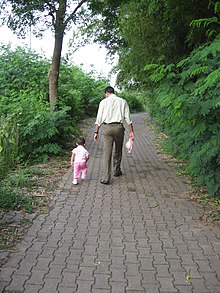
Toddlers are very curious about the world effectually them and are eager to explore it. They seek greater independence and responsibility and may become frustrated when things do non become the way that they want or look. Tantrums begin at this stage, which is sometimes referred to as the 'Terrible Twos'.[67] Tantrums are oft caused by the child'south frustration over the particular situation, and are sometimes caused, only because they are not able to communicate properly. Parents of toddlers are expected to help guide and teach the child, constitute bones routines (such as washing hands earlier meals or brushing teeth before bed), and increase the child's responsibilities. It is also normal for toddlers to be frequently frustrated. It is an essential step to their development. They will learn through experience, trial, and mistake. This means that they need to experience being frustrated when something does not work for them in society to move on to the next phase. When the toddler is frustrated, they volition often misbehave with actions like screaming, striking or biting. Parents demand to exist careful when reacting to such behaviors; giving threats or punishments is usually not helpful and might just make the state of affairs worse.[68] Enquiry groups led by Daniel Schechter, Alytia Levendosky, and others have shown that parents with histories of maltreatment and violence exposure often have difficulty helping their toddlers and preschool-age children with the very same emotionally dysregulated behaviors which can remind traumatized parents of their agin experiences and associated mental states.[69] [lxx] [71]
Regarding gender differences in parenting, information from the US in 2014 states that, on an average mean solar day, amidst adults living in households with children under age 6, women spent 1.0 hours providing physical care (such as bathing or feeding a child) to household children. By dissimilarity, men spent 23 minutes providing physical care.[72]
Child [edit]

Younger children start to get more independent and brainstorm to build friendships. They are able to reason and can make their own decisions in many hypothetical situations. Immature children demand constant attention but gradually learn how to deal with boredom and begin to be able to play independently. They enjoy helping and besides feeling useful and capable. Parents can assist their children by encouraging social interactions and modeling proper social behaviors. A large part of learning in the early on years comes from existence involved in activities and household duties. Parents who observe their children in play or join with them in kid-driven play take the opportunity to glimpse into their children's world, learn to communicate more effectively with their children, and are given another setting to offer gentle, nurturing guidance.[73] Parents also teach their children health, hygiene, and eating habits through pedagogy and by example.
Parents are expected to make decisions about their child's didactics. Parenting styles in this area diverge greatly at this stage, with some parents they choose to become heavily involved in arranging organized activities and early on learning programs. Other parents choose to let the child develop with few organized activities.
Children begin to learn responsibility and consequences for their actions with parental aid. Some parents provide a small-scale assart that increases with age to aid teach children the value of money and how to be responsible.
Parents who are consequent and fair with their discipline, who openly communicate and offer explanations to their children, and who do not neglect the needs of their children in any way frequently find they take fewer problems with their children every bit they mature.
When child acquit issues are encountered, behavioral and cognitive-behavioral group-based parenting interventions have been institute to be effective at improving kid conduct, parenting skills, and parental mental health.[74]
Adolescents [edit]
Parents frequently feel isolated and alone when parenting adolescents.[75] Adolescence tin be a time of loftier adventure for children, where newfound freedoms tin result in decisions that drastically open up or close off life opportunities. In that location are as well large changes that occur in the brain during adolescence; the emotional center of the brain is now fully adult, only the rational frontal cortex hasn't matured fully and nevertheless is not able to continue all of those emotions in check.[76] Adolescents tend to increase the amount of time spent with peers of the reverse gender; nonetheless, they withal maintain the amount of fourth dimension spent with those of the aforementioned gender—and do this by decreasing the amount of time spent with their parents.
Although adolescents look to peers and adults outside the family for guidance and models for how to behave, parents tin can remain influential in their development. Studies have shown that parents tin have a significant impact, for instance, on how much teens beverage.[77]
During boyhood children begin to course their identity and first to examination and develop the interpersonal and occupational roles that they will presume as adults. Therefore, it is important that parents treat them as immature adults. Parental bug at this stage of parenting include dealing with rebelliousness related to a greater desire to partake in risky behaviors. In gild to prevent risky behaviors, it is important for the parents to build a trusting human relationship with their children. This can be achieved through behavioral command, parental monitoring, consistent discipline, parental warmth and support, inductive reasoning, and stiff parent-child communication.[78] [79]
When a trusting relationship is built up, adolescents are more likely to arroyo their parents for help when faced with negative peer pressure. Helping children build a strong foundation will ultimately help them resist negative peer pressure.[ citation needed ]
Adults [edit]
Parenting does not usually end when a kid turns eighteen. Support may be needed in a child'due south life well beyond the adolescent years and can continue into middle and later adulthood. Parenting can exist a lifelong process.
Parents may provide fiscal support to their adult children, which tin can also include providing an inheritance after death. The life perspective and wisdom given by a parent can benefit their developed children in their own lives. Becoming a grandparent is some other milestone and has many similarities with parenting.
Roles can be reversed in some ways when adult children go caregivers to their elderly parents.[80]
Assistance [edit]
Parents may receive aid with caring for their children through child care programs.
Childbearing and happiness [edit]
Data from the British Household Console Survey and the German Socio-Economic Panel suggests that having up to two children increases happiness in the years around the birth, and by and large only for those who accept postponed childbearing. However, having a third kid is not shown to increase happiness.[81]
See also [edit]
 | Wikiquote has quotations related to: Parenting |
- Child custody
- Childlessness
- Developmental psychology
- Empty nest syndrome
- Family unit law
- LGBT parenting
- Motherhood constellation
- Outline of children
- Parent Rescue (documentary series)
- Parental alienation
- Parenting plan
- Parental supervision
- Parenting coordinator
- Paternal age effect
- Paternal care
- Pedagogy
- Shared parenting
- Sharenting
References [edit]
- ^ Jane B. Brooks (28 September 2012). The Process of Parenting: 9th Edition. McGraw-Hill Higher Educational activity. ISBN978-0-07-746918-4. For the legal definition of parenting and parenthood see: Haim Abraham, A Family Is What You Make Information technology? Legal Recognition and Regulation of Multiple Parents (2017)
- ^ Bernstein, Robert (20 February 2008). "Majority of Children Alive With Ii Biological Parents". Archived from the original on 20 April 2008. Retrieved 26 March 2009.
- ^ Johri, Ashish (2 March 2014). "6 Steps for Parents So Your Child is Successful". humanenrich.com . Retrieved 2 March 2014.
- ^ JON., WITT (2017). SOC 2018 (5th ed.). [Due south.l.]: McGraw-Hill. ISBN978-1-259-70272-three. OCLC 968304061.
- ^ Schechter, D.S., & Willheim, E. (2009). Disturbances of zipper and parental psychopathology in early babyhood. Babe and Early on Childhood Mental Health Issue. Child and Adolescent Psychiatry Clinics of North America, xviii(three), 665-87.
- ^ Grienenberger, J., Kelly, K. & Slade, A. (2005). Maternal Reflective Operation, Mother-Infant Affective Communication and Infant Zipper: Exploring The Link Between Mental States and Observed Caregiving. Zipper and Human being Evolution, vii, 299-311.
- ^ Lieberman, A.F.; Padrón, E.; Van Horn, P.; Harris, West.W. (2005). "Angels in the plant nursery: The intergenerational transmission of chivalrous parental influences". Infant Ment. Wellness J. 26 (6): 504–20. CiteSeerX10.i.1.964.1341. doi:ten.1002/imhj.20071. PMID 28682485.
- ^ Lareau, Annette (2002). "Invisible Inequality: Social Class and Kid Rearing in Blackness Families and White Families". American Sociological Review. 67 (5): 747–76. doi:10.2307/3088916. JSTOR 3088916.
- ^ shizuka, P. (2019). Social Class, Gender, and Contemporary Parenting Standards in the United states: Prove from a National Survey Experiment. Social Forces, 98(1), 31–58. https://doi.org/10.1093/sf/soy107
- ^ "20th Century Evolution of American Parenting Styles". Archived from the original on 22 March 2016. Retrieved xi May 2015. .
- ^ Weiten, W.; McCann, D. (2007). Themes and Variations . Nelson Education Ltd: Thomson Wadsworth. ISBN978-0-17-647273-iii.
- ^ "Function of Social class in parenting". Budingstar. 7 January 2020.
- ^ Doob, Christopher (2013) (in English). Social Inequality and Social Stratification (1st ed. ed.). Boston: Pearson. p. 165.
- ^ a b *Spera, C (2005). "A review of the relationship amongst parenting practices, parenting styles, and adolescent school achievement" (PDF). Educational Psychology Review. 17 (2): 125–46. CiteSeerXten.i.1.596.237. doi:x.1007/s10648-005-3950-one. S2CID 11050947.
- ^ Baumrind, D. (1967). Child care practices anteceding three patterns of preschool behavior. Genetic Psychology Monographs, 75, 43–88.
- ^ Baumrind, D. (1971). Current patterns of parental authorization" Developmental Psychology four (1, Pt. 2), 1–103.
- ^ Baumrind, D. (1978). "Parental disciplinary patterns and social competence in children". Youth & Society. 9 (iii): 238–76. doi:10.1177/0044118X7800900302. S2CID 140984313.
- ^ McKay M (2006). Parenting Practices in Emerging Adulthood: Development of a New Measure out. Thesis, Brigham Young Academy. Retrieved ix February 2016.
- ^ Santrock, J.Westward. (2007). A topical arroyo to life-span development, 3rd Ed. New York: McGraw-Hill.
- ^ Rubin, Mark (2015). "Social Class Differences in Mental Health: Do Parenting Way and Friendship Play a Role?". Mark Rubin Social Psychology Research. Archived from the original on two February 2016. Retrieved 29 August 2017.
- ^ Rubin, Thou.; Kelly, B Yard. (2015). "A cross-sectional investigation of parenting style and friendship as mediators of the relation between social form and mental health in a university community". International Journal for Equity in Health. fourteen (87): ane–11. doi:10.1186/s12939-015-0227-2. PMC4595251. PMID 26438013.
- ^ Hedstrom, Ellen (2016). Parenting Style equally a Predictor of Internal and External Behavioural Symptoms in Children : The Kid's Perspective.
- ^ Joseph Chiliad. V., John J. (2008). Global Academic Guild Periodical: Social Scientific discipline Insight, Vol. ane, No. five, pp. 16-25. ISSN 2029-0365 "Touch on of Parenting Styles on Kid Development".
- ^ a b Fletcher, A. C.; Walls, J.G.; Cook, E.C.; Madison, One thousand.J.; Bridges, T.H. (December 2008). "Parenting Style every bit a Moderator of Associations Betwixt Maternal Disciplinary Strategies and Child Well-Beingness" (PDF). Journal of Family Issues. 29 (12): 1724–44. doi:10.1177/0192513X08322933. S2CID 38460545.
- ^ Friedson, Michael (1 January 2016). "Authoritarian parenting attitudes and social origin: The multigenerational relationship of socioeconomic position to childrearing values". Kid Abuse & Neglect. 51: 263–275. doi:10.1016/j.chiabu.2015.10.001. ISSN 0145-2134. PMID 26585215.
- ^ Famlii (ii Feb 2015). "Parenting Styles and Wealth: Concerted Cultivation past Annette Lareau". Famlii . Retrieved 15 April 2021.
- ^ Zahedani ZZ, Rezaee R, Yazdani Z, Bagheri S, Nabeiei P. J Adv Med Educ Prof. 2016; 4:130–iv ZAHED ZAHEDANI Z; REZAEE R; YAZDANI Z; BAGHERI S; NABEIEI P (2016). "The Influence of Parenting Way on Bookish Achievement and Career Path". Journal of Advances in Medical Instruction & Professionalism. 4 (3): 130–134. PMC4927255. PMID 27382580.
- ^ Lassonde, Stephen (2017). "Dominance, disciplinary intimacy & parenting in middle-grade America". European Periodical of Developmental Psychology. xiv (half dozen): 714–732. doi:10.1080/17405629.2017.1300577. S2CID 151783083.
- ^ "permissive parenting". MSU.EDU.
- ^ a b Brown, Lola; Iyengar, Shrinidhi (2008). "Parenting Styles: The Impact on Educatee Achievement". Marriage & Family Review. 43 (one–2): 14–38. doi:10.1080/01494920802010140. S2CID 144129154.
- ^ Finkelhor, D.; Ormrod, R.; Turner, H.; Holt, Grand. (November 2009). "Pathways to Poly-Victimization" (PDF). Kid Maltreatment. xiv (4): 316–29. doi:10.1177/1077559509347012. PMID 19837972. S2CID 14676857.
- ^ Bolin, Inge. Growing Upwards in a Culture of Respect: Child Rearing in Highland Peru. Austin: Academy of Texas Printing, 2006. Project MUSE.[ page needed ]
- ^ a b Day, Nicholas (30 April 2013). "Cultural differences in how you look and talk at your babe". Slate . Retrieved 3 May 2013.
- ^ Olcer, Sevinc; Aytar, Abide Gungor (25 August 2014). "A Comparative Written report into Social Skills of 5-vi Yr Old Children and Parental Behaviors". Procedia - Social and Behavioral Sciences. 141: 976–995. doi:10.1016/j.sbspro.2014.05.167.
- ^ Patterson et al. (1992)
- ^ Chase-Lansdale, Cherlin & Kiernan, 1995; Hetherington, 1992; Zill, Morrison & Coiro, 1993; Bumpass, Sugariness & Martin, 1990; Hetherington, Bridges & Insabella, 1998
- ^ Sanders, Matthew R. (2008). "Triple P-Positive Parenting Plan as a public wellness arroyo to strengthening parenting" (PDF). Journal of Family Psychology. 22 (4): 506–17. CiteSeerX10.1.one.1012.8778. doi:10.1037/0893-3200.22.three.506. PMID 18729665.
- ^ Mutual Sense Parenting, Burke, 1997, p. 83
- ^ Amend Home Discipline, Cutts, 1952, p. vii
- ^ Barlow, Jane; Smailagic, Nadja; Huband, Nick; Roloff, Verena; Bennett, Cathy (17 May 2014). "Grouping-based parent grooming programmes for improving parental psychosocial health". The Cochrane Database of Systematic Reviews (v): CD002020. doi:10.1002/14651858.CD002020.pub4. ISSN 1469-493X. PMID 24838729.
- ^ a b c d e f Twenty-four hour period, Nicholas (x April 2013). "Parental ethnotheories and how parents in America differ from parents everywhere else". Slate . Retrieved 19 April 2013.
- ^ Day, Nicholas (9 Apr 2013). "Give Your Babe a Machete and Other #BabySlatePitches". Slate . Retrieved nineteen Apr 2013.
- ^ Bolin, Inge (2006). Growing Up in a Civilization of Respect: Kid Rearing in Highland Peru . University of Texas Press. pp. 63–67. ISBN978-0-292-71298-0.
- ^ Robert K. Thomas. 1958. "Cherokee Values and World View" Unpublished MS, University of N Carolina Available at: http://works.bepress.com/robert_thomas/40 Archived v March 2016 at the Wayback Car
- ^ Bolin, Inge. Growing Up in a Civilization of Respect: Child Rearing in Highland Peru. Austin: University of Texas Press, 2006. Project MUSE. Web. xiii May. 2014. <http://muse.jhu.edu/>.[ folio needed ]
- ^ Doan, Stacey Northward. (May 2017). "Consequences of 'Tiger' Parenting: A Cross-Cultural Study of Maternal Psychological Control and Children's Cortisol Stress Response". Developmental Science. twenty (3): x. doi:ten.1111/desc.12404. hdl:2027.42/136743. PMID 27146549.
- ^ Archibald, Jo-Ann, (2008). Indigenous Storywork: Educating The Middle, Mind, Trunk and Spirit. Vancouver, British Columbia: The University of British Columbia Press.[ page needed ]
- ^ Delgado-Gaitan, Concha (1994). "Consejos: The Power of Cultural Narratives". Anthropology & Educational activity Quarterly. 25 (iii): 298–316. doi:10.1525/aeq.1994.25.3.04x0146p. JSTOR 3195848.
- ^ Brown, P. (2002). Anybody has to lie in Tzeltal. (pp. 241–75) Lawrence Erlbaum Associates Publishers, Mahwah, NJ.
- ^ a b c Source: Chisholm, J.S. (1996). Learning "respect for everything": Navajo images of development. Images of childhood, 167–183.
- ^ Paradise, Ruth; Rogoff, Barbara. "Side by Side: Learning by Observing and Pitching In". Journal of the Society of Psychological Anthropology: 102–37.
- ^ Gaskins, Suzanne; Paradise, Ruth (2010). "Learning Through Observation in Daily Life". In Lancy, David; Bock, John; Gaskins, Suzanne (eds.). The Anthropology of Learning in Babyhood. United Kingdom: AltaMira Press.
- ^ a b c d e f g h i j k l k n o p q r Wang, Ming-Te; Henry, Daphne A.; Smith, Leann 5.; Huguley, James P.; Guo, Jiesi (January 2020). "Parental ethnic-racial socialization practices and children of colour'south psychosocial and behavioral adjustment: A systematic review and meta-analysis". American Psychologist. 75 (1): 1–22. doi:10.1037/amp0000464. ISSN 1935-990X. PMID 31058521. S2CID 145820076.
- ^ Lee, Richard M.; Grotevant, Harold D.; Hellerstedt, Wendy L.; Gunnar, Megan R. (December 2006). "Cultural socialization in families with internationally adopted children". Periodical of Family unit Psychology. twenty (iv): 571–580. doi:10.1037/0893-3200.twenty.4.571. ISSN 1939-1293. PMC2398726. PMID 17176191.
- ^ McHale, Susan M.; Crouter, Ann C.; Kim, Ji-Yeon; Burton, Linda One thousand.; Davis, Kelly D.; Dotterer, Aryn M.; Swanson, Dena P. (September 2006). "Mothers' and Fathers' Racial Socialization in African American Families: Implications for Youth". Child Development. 77 (v): 1387–1402. doi:10.1111/j.1467-8624.2006.00942.x. hdl:2027.42/97223. ISSN 0009-3920. PMID 16999806.
- ^ a b Bannon, William M.; McKay, Mary M.; Chacko, Anil; Rodriguez, James A.; Cavaleri, Mary (Jan 2009). "Cultural Pride Reinforcement as a Dimension of Racial Socialization Protective of Urban African American Kid Feet". Families in Society: The Journal of Contemporary Social Services. 90 (i): 79–86. doi:ten.1606/1044-3894.3848. ISSN 1044-3894. PMC2749692. PMID 20046919.
- ^ Huguley, James P.; Wang, Ming-Te; Vasquez, Ariana C.; Guo, Jiesi (May 2019). "Parental ethnic–racial socialization practices and the construction of children of colour'south ethnic–racial identity: A research synthesis and meta-analysis" (PDF). Psychological Bulletin. 145 (five): 437–458. doi:10.1037/bul0000187. ISSN 1939-1455. PMID 30896188. S2CID 84845230.
- ^ Priest, Naomi; Walton, Jessica; White, Fiona; Kowal, Emma; Baker, Alison; Paradies, Yin (November 2014). "Agreement the complexities of ethnic-racial socialization processes for both minority and majority groups: A 30-year systematic review". International Journal of Intercultural Relations. 43: 139–155. doi:10.1016/j.ijintrel.2014.08.003. ISSN 0147-1767.
- ^ a b Yasui, Miwa (September 2015). "A review of the empirical assessment of processes in ethnic–racial socialization: Examining methodological advances and time to come areas of development". Developmental Review. 37: one–40. doi:10.1016/j.physician2015.03.001. ISSN 0273-2297.
- ^ Sedgh, Gilda; Singh, Susheela; Hussain, Rubina (10 September 2014). "Intended and Unintended Pregnancies Worldwide in 2012 and Contempo Trends". Studies in Family Planning. 45 (three): 301–fourteen. doi:x.1111/j.1728-4465.2014.00393.x. ISSN 0039-3665. PMC4727534. PMID 25207494.
- ^ a b Dean, Sohni V.; Lassi, Zohra S.; Imam, Ayesha M.; Bhutta, Zulfiqar A. (26 September 2014). "Preconception care: nutritional risks and interventions". Reproductive Health. xi Suppl iii: S3. doi:10.1186/1742-4755-11-S3-S3. PMC4196560. PMID 25415364.
- ^ Morris Eaves; Robert Northward. Essick; Joseph Viscomi (eds.). "Songs of Innocence and of Experience, copy AA, object 25 (Bentley 25, Erdman 25, Keynes 25) "Babe Joy"". William Blake Archive. Archived from the original on 17 January 2014. Retrieved 16 January 2014.
- ^ Gartner LM; Morton J; Lawrence RA; Naylor AJ; O'Hare D; Schanler RJ; Eidelman AI; et al. (Feb 2005). "Breastfeeding and the Use of Homo Milk". Pediatrics. 115 (2): 496–506. doi:10.1542/peds.2004-2491. PMID 15687461.
- ^ van der Voort, Anja; Juffer, Femmie; J. Bakermans-Kranenburg, Marian (1 Jan 2014). Barlow, Jane (ed.). "Sensitive parenting is the foundation for secure attachment relationships and positive social-emotional development of children". Periodical of Children's Services. 9 (ii): 165–176. doi:ten.1108/JCS-12-2013-0038. ISSN 1746-6660.
- ^ SS, Hamilton. "Outcome Filters." National Center for Biotechnology Information. U.S. National Library of Medicine, one October 2008. Web. 13 March 2013.
- ^ "Teaching Kids to Mind Their Manners: How to Raise a Polite Child".
- ^ "The Terrible Twos Explained – Prophylactic Kids (UK)". Safety Kids. 10 May 2011. Retrieved 2 May 2012.
- ^ Pitman, Teresa. "Toddler Frustration". Todaysparent. Retrieved 3 December 2011.
- ^ Schechter, Daniel S.; Willheim, Erica; Hinojosa, Claudia; Scholfield-Kleinman, Kimberly; Turner, J. Blake; McCaw, Jaime; Zeanah, Charles H.; Myers, Michael M. (2010). "Subjective and Objective Measures of Parent-Child Relationship Dysfunction, Child Separation Distress, and Joint Attending". Psychiatry. 73 (two): 130–44. doi:10.1521/psyc.2010.73.2.130. PMID 20557225. S2CID 5132495.
- ^ Schechter, Daniel S.; Zygmunt, Annette; Coates, Susan W.; Davies, Marker; Trabka, Kimberly A.; McCaw, Jaime; Kolodji, Ann; Robinson, Joann L. (2007). "Caregiver traumatization adversely impacts young children'southward mental representations on the MacArthur Story Stalk Bombardment". Attachment & Human Development. 9 (three): 187–205. doi:x.1080/14616730701453762. PMC2078523. PMID 18007959.
- ^ Levendosky, Alytia A.; Leahy, Kerry Fifty.; Bogat, G. Anne; Davidson, William Due south.; von Heart, Alexander (2006). "Domestic violence, maternal parenting, maternal mental health, and infant externalizing behavior". Journal of Family Psychology. 20 (iv): 544–52. doi:10.1037/0893-3200.20.4.544. PMID 17176188.
- ^ "American Fourth dimension Apply Survey". Bureau of Labor Statistics. 24 June 2015.
- ^ Kenneth R. Ginsburg. "The Importance of Play in Promoting Good for you Child Development and Maintaining Strong Parent-Kid Bonds" (PDF). American Academy of Pediatrics. Archived from the original (PDF) on 11 October 2009.
- ^ Chiliad, Furlong; S, McGilloway; T, Bywater; J, Hutchings; Sm, Smith; G, Donnelly (15 February 2012). "Behavioural and Cognitive-Behavioural Grouping-Based Parenting Programmes for Early-Onset Conduct Issues in Children Anile 3 to 12 Years". The Cochrane Database of Systematic Reviews (2): CD008225. doi:ten.1002/14651858.CD008225.pub2. PMID 22336837.
- ^ Sharenting – At present became Oversharenting & Danger Archived 16 Baronial 2016 at the Wayback Machine
- ^ "WHAT WAS MY TEENAGER THINKING?". Talking to Teens. 26 September 2017. Retrieved 12 Feb 2018.
- ^ "vii Things Most Parents Get Wrong Most Teen Drinking". Talking to Teens. seven July 2017. Retrieved 12 February 2018.
- ^ Hoskins, Donna (18 September 2014). "Consequences of Parenting on Adolescent Outcomes". Societies. iv (3): 506–531. doi:ten.3390/soc4030506. ISSN 2075-4698.
- ^ Newman, Kathy; Harrison, Lynda; Dashiff, Carol; Davies, Susan (February 2008). "Relationships between parenting styles and risk behaviors in adolescent wellness: an integrative literature review". Revista Latino-Americana de Enfermagem. xvi (1): 142–150. doi:10.1590/S0104-11692008000100022. ISSN 0104-1169. PMID 18392544.
- ^ Dellmann-Jenkins, Mary; Blankemeyer, Maureen; Pinkard, Odessa (Apr 2000). "Immature Adult Children and Grandchildren in Chief Caregiver Roles to Older Relatives and Their Service Needs". Family Relations. 49 (ii): 177–186. doi:ten.1111/j.1741-3729.2000.00177.10. ISSN 0197-6664.
- ^ Mikko Myrskylä; Rachel Margolis (2014). "Happiness: Before and Subsequently the Kids". Demography. 51 (5): 1843–66. CiteSeerX10.i.1.454.2051. doi:x.1007/s13524-014-0321-x. PMID 25143019. S2CID 8127506.
Further reading [edit]
- Robert Levine; Sarah Levine (2017). Practice Parents Matter?: Why Japanese Babies Sleep Soundly, Mexican Siblings Don't Fight & Parents Should Just Relax. Souvenir Press. ISBN978-0285643703.
External links [edit]
Source: https://en.wikipedia.org/wiki/Parenting
0 Response to "Which 2 Examples of Supporting Families During Transition Is the Most Effective and Why?"
Post a Comment